I. INTRODUCTION
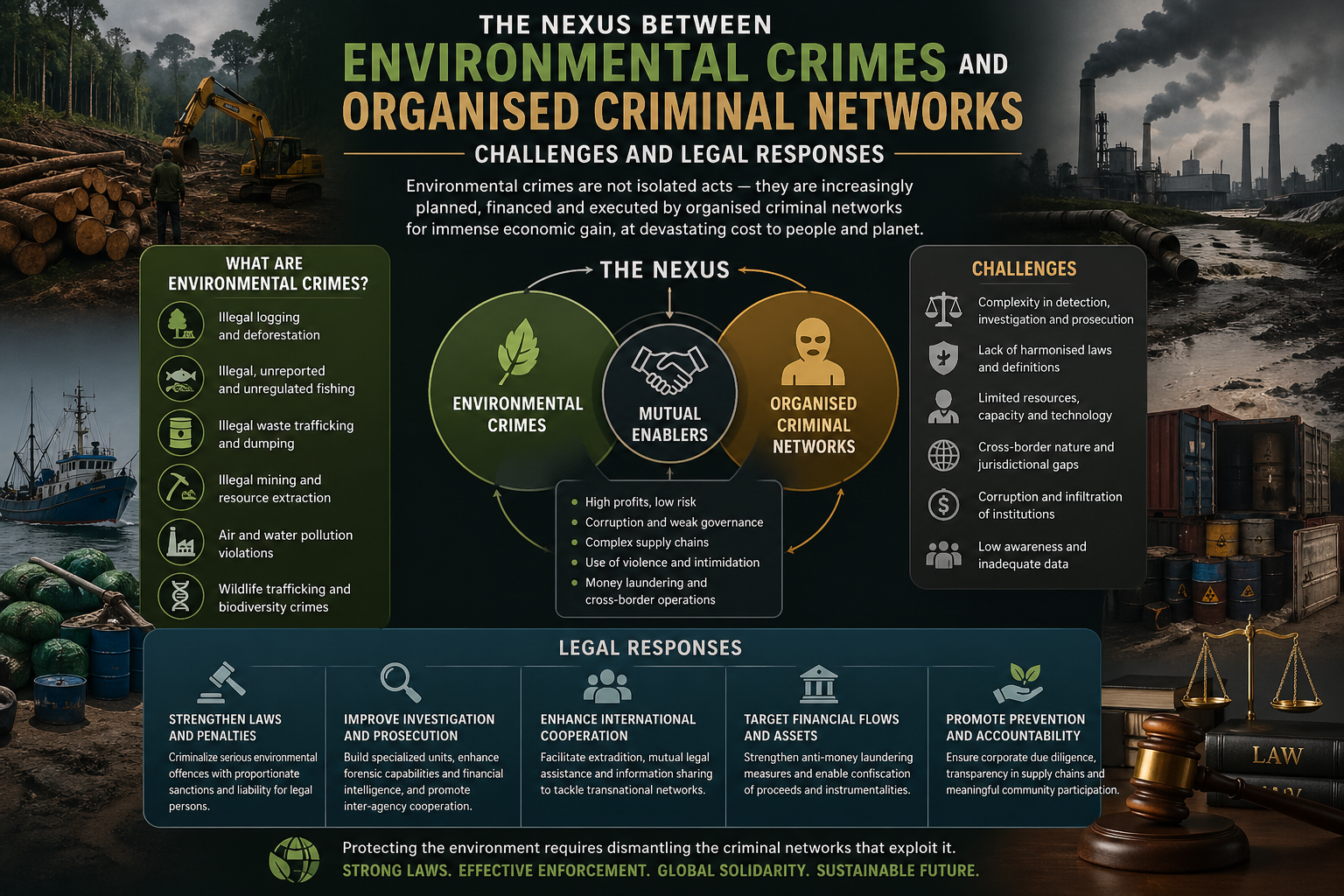
Environmental crime refers to unlawful acts that directly harm the environment, including illegal wildlife trade, unregulated mining, deforestation, hazardous waste disposal, and pollution-related offences. Once viewed as peripheral regulatory violations, these crimes have evolved into a major global concern due to their scale, profitability, and long-term ecological consequences. In recent decades, a troubling trend has emerged: the increasing involvement of organisedcriminal networks in environmental exploitation. These networks operate across borders, using sophisticated methods, corruption, and violence to extract and traffic natural resources with minimal risk of detection.
The growing nexus between environmental crime and organised crime is driven by several factors. Environmental offences often yield high financial returns while attracting comparatively low penalties, making them an attractive alternative to traditional illicit markets such as narcotics or arms trafficking. Additionally, weak governance, inadequate enforcement, and gaps in international cooperation create opportunities for criminal syndicates to flourish. As a result, environmental crime is no longer merely an ecological issue but a serious threat to national security, economic stability, and sustainable development.
Moreover, the transnational nature of these crimes complicates enforcement efforts. Environmental crimes often involve multiple jurisdictions, making investigation and prosecution challenging. For instance, wildlife may be poached in one country, transported through another, and sold in international markets, requiring coordinated action among enforcement agencies across borders. The lack of harmonisedlegal standards and effective information-sharing mechanisms further exacerbates the problem.
In this context, environmental crime can no longer be viewed solely as an ecological or conservation issue; it must be understood as a serious form of organised criminal activity with far-reaching implications. Addressing this growing nexus requires a comprehensive legal and institutional response that integrates environmental protection with criminal law enforcement. Strengthening regulatory frameworks, enhancing inter-agency coordination, and fostering international cooperation are essential to effectively combat this evolving threat and ensure sustainable management of natural resources.
II. CONCEPTUAL FRAMEWORK: DEFINING THE NEXUS
A. Environmental Crime: Definitional Contours
Environmental crime lacks a universally accepted definition, contributing to inconsistencies in legal responses across jurisdictions. The United Nations Environment Programme (UNEP) conceptualises environmental crime as “illegal activities harming the environment and aimed at benefitting individuals or groups or companies from the exploitation of, damage to, trade or theft of natural resources.’’ This definition encompasses a spectrum of conduct, from regulatory violations to serious transnational offences.
The primary categories of environmental crime include:
B. Organised Crime: Structural Characteristics
The United Nations Convention against Transnational Organised Crime (UNTOC) defines an “organised criminal group” as “a structured group of three or more persons, existing for a period of time and acting in concert with the aim of committing one or more serious crimes or offences in order to obtain, directly or indirectly, a financial or other material benefit.’’
Transnational criminal organisations (TCOs) engaged in environmental crime exhibit distinctive operational characteristics:
The gravitation of organised criminal networks toward environmental crime is attributable to a distinctive risk-reward calculus. Environmental crimes offer high profitability with comparatively low detection rates and modest penalties relative to drug trafficking or other serious offences.The Financial Action Task Force (FATF) has identified environmental crime as a significant money laundering predicate, with proceeds often laundered through legitimate businesses, shell companies, and trade-based mechanisms.
The OECD’s analysis identifies several structural drivers:
III. STATUTORY FRAMEWORK
A. Indian Legal Architecture
India has developed a comprehensive, albeit fragmented, legislative framework addressing environmental protection and wildlife conservation.
Wildlife Protection Act, 1972
The Wildlife Protection Act, 1972 (WLPA) constitutes the primary instrument for wildlife conservation and anti-poaching enforcement. The Act establishes a system of protected areas, regulates hunting and trade in wildlife, and prescribes penalties for violations.
Key provisions relevant to organised crime:
The 2022 Amendment to the WLPA introduced significant reforms, including enhanced penalties and provisions for specimen custody, aligning domestic law more closely with CITES obligations.
Environment (Protection) Act, 1986
The Environment (Protection) Act, 1986 (EPA) serves as umbrella legislation empowering the Central Government to take measures for environmental protection. Section 15 provides for penalties including imprisonment up to five years and fines for violations, with enhanced penalties for continuing offences.
Forest (Conservation) Act, 1980
This Act regulates the diversion of forest land for non-forest purposes, requiring prior Central Government approval. It addresses one dimension of illegal logging but lacks specific provisions to target organised criminal involvement.
Prevention of Money Laundering Act, 2002
The Prevention of Money Laundering Act, 2002 (PMLA) assumes critical importance in targeting the financial dimensions of organised environmental crime. Following amendments, proceeds from scheduled offences, including certain wildlife crimes, are subject to PMLA provisions, enabling asset attachment and confiscation.
B. International Legal Instruments
Convention on International Trade in Endangered Species (CITES)
CITES, ratified by India in 1976, regulates international trade in specimens of wild fauna and flora through a tiered permit system. Species are listed in three Appendices based on conservation status, with Appendix I species receiving the highest protection. India has implemented CITES through the WLPA, designating the Wildlife Crime Control Bureau (WCCB) as the national enforcement authority.
United Nations Convention against Transnational Organised Crime (UNTOC)
The UNTOC provides the foundational framework for international cooperation against organised crime. While not specifically addressing environmental crimes, its provisions on mutual legal assistance, extradition, and law enforcement cooperation apply to transnational environmental criminal networks.
Basel Convention
The Basel Convention on the Control of Transboundary Movements of Hazardous Wastes and their Disposal regulates international waste trafficking, requiring prior informed consent for transboundary movements. India ratified the Convention in 1992 and implemented it through the Hazardous and Other Wastes (Management and Transboundary Movement) Rules, 2016.
INTERPOL Environmental Security Programme
INTERPOL’s Environmental Security unit coordinates international law enforcement operations targeting environmental crime, facilitating intelligence sharing and joint operations. India participates actively in INTERPOL initiatives, including Operations Thunderball and Ramp,targeting wildlife trafficking.
IV. CASE LAW ANALYSIS
A. Indian Jurisprudence
State of West Bengal v. Anwar Ali Sarkar
Citation: AIR 1952 SC 75
Facts: While not directly concerning environmental crime, this foundational case established principles regarding special legislation and equal protection that inform subsequent environmental crime jurisprudence.
Ratio decidendi: The Supreme Court held that special legislation must have a reasonable classification based on intelligible differentia having a rational nexus with the object sought to be achieved.
Relevance: This principle underlies the constitutional validity of specialised environmental crime legislation and the creation of distinct enforcement mechanisms for organisedenvironmental criminality.
Centre for Environmental Law, WWF-India v. Union of India
Citation: (2013) 8 SCC 234
Facts: The petition sought directions regarding the implementation of CITES obligations and the strengthening of enforcement mechanisms against wildlife trafficking networks.
Issues: Whether India had adequately implemented its international obligations under CITES; whether existing enforcement mechanisms were sufficient to combat organisedwildlife crime.
Ratio decidendi: The Supreme Court directed the strengthening of the Wildlife Crime Control Bureau, enhanced coordination between enforcement agencies, and implementation of a centralised wildlife crime database. The Court recognised the organised and transnational nature of wildlife trafficking.
Relevance: This judgment acknowledged the organized crime dimension of wildlife trafficking and mandated institutional reforms to address it.
T.N. Godavarman Thirumulpad v. Union of India
Citation: (1997) 2 SCC 267 and subsequent orders
Facts: This public interest litigation concerning forest conservation evolved into ongoing judicial supervision of forest governance across India.
Issues: Illegal logging, encroachment on forest lands, and the involvement of criminal networks in timber trafficking.
Ratio decidendi: The Supreme Court issued comprehensive directions for forest protection, including the establishment of the Central Empowered Committee, prohibition of felling in certain areas, and enhanced monitoring mechanisms. The Court observed the nexus between illegal logging and organised networks, noting the involvement of “timber mafias” operating across state boundaries.
Relevance: The continuing mandamus demonstrates judicial recognition of organised criminal involvement in illegal logging and the need for a sustained institutional response.
B. International Jurisprudence
The Prosecutor v. Ahmad Al Faqi Al Mahdi
Citation: ICC-01/12-01/15, International Criminal Court (2016)
Facts: The accused was charged with directing attacks against religious and historic buildings in Timbuktu, Mali, constituting war crimes under Article 8(2)(e)(iv) of the Rome Statute.
Issues: Whether the destruction of cultural and protected sites could constitute international crimes warranting ICC jurisdiction.
Ratio decidendi: The ICC convicted the accused, marking the first prosecution focused on cultural destruction. The judgment established that deliberate destruction of protected heritage constitutes a war crime, with potential implications for environmental destruction during armed conflict.
Relevance: This case represents nascent international criminal accountability for environmental and cultural destruction, potentially extending to ecocide in future jurisprudence.
Costa Rica v. Nicaragua (Certain Activities)
Citation: ICJ Reports 2015, p. 665
Facts: Costa Rica alleged that Nicaragua had unlawfully occupied and caused environmental damage to the disputed territory, including dredging activities affecting wetlands.
Issues: State responsibility for transboundary environmental harm; compensation for environmental damage.
Ratio decidendi: The International Court of Justice found Nicaragua responsible for environmental damage and ordered compensation, applying the principle that states bear responsibility for environmental harm caused to other states’ territory.
Relevance: The judgment reinforces international environmental accountability principles applicable to state-sponsored or tolerated environmental crimes affecting other jurisdictions.
V. CHALLENGES IN ENFORCEMENT
The enforcement of legal frameworks against organisedenvironmental crime confronts formidable obstacles.
A. Jurisdictional and Evidentiary Challenges
Environmental crimes characteristically span multiple jurisdictions, creating coordination challenges among enforcement agencies. The gathering of admissible evidence across borders requires mutual legal assistance mechanisms that are often slow and cumbersome.
B. Resource Constraints and Capacity Deficits
Enforcement agencies frequently lack adequate personnel, training, and technological resources. The Wildlife Crime Control Bureau operates with limited staff relative to the scale of trafficking through Indian territory. Frontline personnel often lack specialised training in forensic investigation, financial analysis, and international cooperation procedures.
C. Corruption and Governance Deficits
Corruption constitutes perhaps the most significant obstacle to effective enforcement. Criminal networks routinely exploit corrupt officials to secure impunity, facilitate border crossings, and compromise investigations. Studies indicate that there are certain corrupt workers who are working together with traders and poachers, who significantly undermine enforcement effectiveness.
D. Low Penalties and Deterrent Effect
Despite recent amendments enhancing penalties, sanctions for environmental crimes remain disproportionately low compared to other serious offences. This penalty asymmetry contributes to the low-risk, high-return calculus that attracts organised networks to environmental crime.
E. Demand-Side Factors
Consumer demand for wildlife products, timber, and other illegally traded commodities sustains criminal markets. Addressing demand requires sustained public awareness campaigns, behavioural interventions, and international cooperation measures that lie beyond traditional enforcement approaches.
VI. CRITICAL EVALUATION AND RECOMMENDATIONS
A. Strengths of Current Framework
The Indian legal framework demonstrates several strengths:
B. Weaknesses and Gaps
Significant deficiencies persist:
C. Recommendations
VII. CONCLUSION
The nexus between environmental crimes and organisedcriminal networks represents one of the defining enforcement challenges of the contemporary era. The sophistication, scale, and transnational reach of criminal operations demand correspondingly sophisticated legal and institutional responses. India’s legal framework, while comprehensive in scope, requires strengthening through legislative reform, enhanced inter-agency coordination, and deeper international cooperation.
The judiciary has demonstrated commendable vigilance in recognising the organised dimensions of environmental crime and mandating institutional reforms. However, judicial intervention alone cannot substitute for sustained executive action and legislative modernisation. The path forward requires an integrated approach combining robust enforcement, financial investigation, demand reduction, and international cooperation.
As climate change and biodiversity loss accelerate, the stakes of this enforcement challenge continue to escalate. Environmental crimes are no longer merely regulatory violations-they constitute serious threats to ecological integrity, human security, and sustainable development. The legal response must match the gravity of this threat through comprehensive, coordinated, and sustained action across jurisdictions.