Objectives, Scope, and Judicial Dimensions: A Critical Legal Analysis
By Hargun Kaur
(BBA LLB (hons.) Lovely Professional University)
I. INTRODUCTION
Organised crime and terrorism are not merely law enforcement problems but they are the constitutional crises that corrode the very sinew of democratic governance. They intimidate witnesses, corrupt public officials, distort market economies and provide financing for ideological violence. Across the world, ordinary criminal law designed for individual transgressors has proven structurally insufficient against hierarchically organised, financially sophisticated criminal enterprises. India has responded through a succession of special laws such as TADA (1987, repealed 1995), POTA (2002, repealed 2004), the Unlawful Activities (Prevention) Act, 1967 (as amended in 2004 and 2019), and state level anti-organised crime statutes modelled on the Maharashtra Control of Organised Crime Act, 1999 (MCOCA). Gujarat’s entry into this legislative fraternity with the Gujarat Control of Terrorism and Organised Crime Act, 2015 (hereinafter, ‘the Act’ or ‘GCTOCA’) is the product of a sixteen year political and constitutional contest, marked by three Presidential rejections, sustained civil liberties opposition, and eventual promulgation on 5th November 2019.
The Act received the assent of President Ram Nath Kovind on 15thOctober, 2019 and was published in the Gujarat Government Gazette Extraordinary (Vol. LX, No. 25, 5 November 2019) as Gujarat Act No. 24 of 2019. The State Government brought it into force with effect from 1st December, 2019. The Gujarat Control of Terrorism and Organised Crime (Amendment) Act, 2022 (Gujarat Act No. 9 of 2022), which received the Governor’s assent on 26thSeptember, 2022 and was deemed to have come into force on 15thJuly, 2022 made three material amendments:
This blog offers a comprehensive, section by section analysis of the Act in its amended form, its legislative genesis, definitional architecture, penal structure, institutional framework, evidentiary innovations, procedural modifications, and the evolving judicial landscape. The analysis is grounded exclusively in the bare text of the Act as published in the Gujarat Government Gazette (PRS Legislative Research repository), the text of the 2022 Amendment, decisions of the Supreme Court and the Gujarat High Court, and peer reviewed academic commentary.
II. LEGISLATIVE HISTORY
The Statement of Objects and Reasons appended to the 2015 Bill catalogues the legislature’s own justification for the Act. It identifies five grounds:
The Bill was first introduced in the Gujarat Legislative Assembly in April 2003, modelled substantially on MCOCA 1999. President A.P.J. Abdul Kalam returned it without assent in 2004, objecting primarily to Clause 16 which made confessions before police officers admissible as being inconsistent with Article 20(3) of the Constitution (protection against self-incrimination) and insufficiently safeguarded. A second version was submitted under President Pratibha Patil, who returned it in 2008 on analogous grounds regarding the confession provision and the bail clause.
A third attempt in 2015 before President Pranab Mukherjee similarly failed.
Only the fourth attempt, with significant modifications informed by the Supreme Court’s 2008 judgment in State of Maharashtra v. Bharat Shanti Lal Shah regarding MCOCA’ss analogous provisions, succeeded in obtaining Presidential assent in October 2019.
The Act’s tempestuous legislative history is not a peripheral curiosity, it is legally material. Each Presidential rejection functioned as a constitutional audit of the Bill’s provisions. The modifications made across successive versions reflect the legislature’s attempt to bring the Act within the bounds of Articles 20 and 21. This iterative constitutionalisation process gives the final enacted text a degree of structural robustness, even as critics argue that several provisions remain constitutionally precarious.
III. OBJECTIVES OF THE ACT
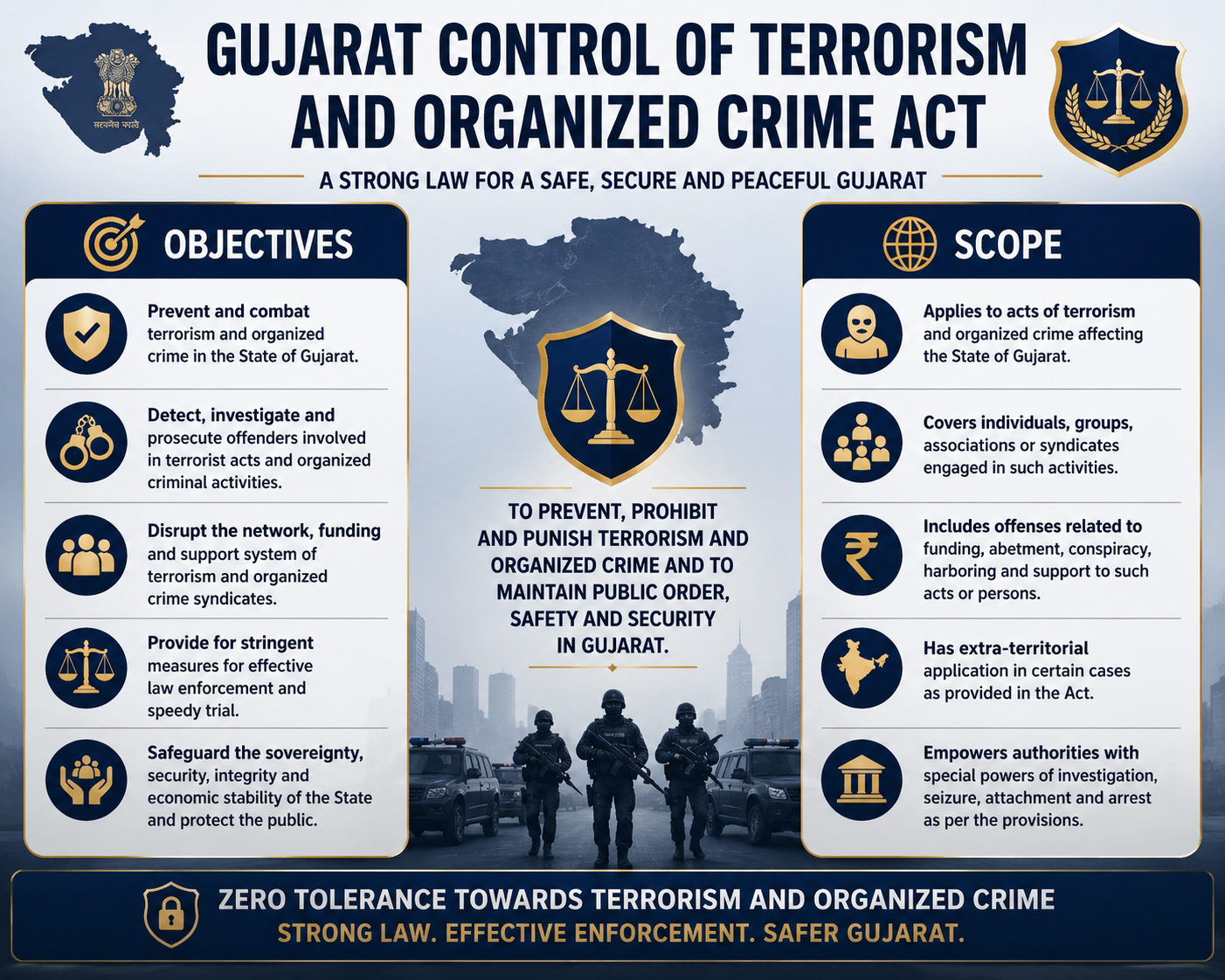
The Preamble of the Act declares its purpose to be “to make special provisions for prevention and control of terrorist acts and for coping with criminal activities by organised crime and for the matters connected therewith or incidental thereto.” This spare statutory declaration encapsulates a multi-dimensional legislative programme that may be disaggregated into five distinct objectives:
IV. SCOPE OF THE ACT
The operational ambit and scope of GCTOCA is determined by its definitions under Section 2(1), read with the 2022 Amendment. These definitions are not mere lexical exercises but they are the gateway through which the Act’s formidable procedural and penal machinery is engaged. A mistaken invocation triggered by imprecise definitions can cause catastrophic consequences for the accused’s liberty. The Gujarat High Court itself issued notice to the State Government specifically seeking clarification on the definition of ‘continuing unlawful activity’ under Section 2(1)(c), underscoring the definitional complexity that pervades the Act.
The Act defines “abet” (helping or assisting in a crime) very broadly. It covers not just people who directly participate in a crime, but also:
(i) anyone who knowingly communicates with or is connected to a member of an organised crime gang, knowing about their criminal activities,
(ii) anyone who passes on or publishes information or documents obtained from such a gang and
(iii) anyone who provides financial or any other kind of support for offences under the Act. This wide definition ensures that the financiers, information providers, and logistical supporters of criminal gangs who may never commit violence themselves are still caught by the law.
This is the foundational threshold concept of the Act. ‘Continuing unlawful activity’ means any activity: (a) prohibited by law and constituting a cognisable offence punishable with imprisonment of three years or more, (b) undertaken singly or jointly as a member of an organised crime syndicate or on its behalf, (c) in respect of which more than one charge sheet has been filed before a competent court within the preceding ten years and (d) where that court has taken cognisance of the offence.
The ten year lookback window and the requirement of multiple charge sheets followed by cognisance are critical threshold safeguards. The Supreme Court in State of Gujarat v. Sandip Omprakash Gupta definitively held that ‘continuing unlawful activity’ as defined in Section 2(1)(c) necessarily requires at least two charge sheets to have been filed before a competent court during the preceding ten years and cognisance to have been taken, but does not require those charge sheets to have been filed exclusively after the Act came into force on 1st December, 2019. Previous chargesheets registered under the IPC or other laws can constitute the pattern of ‘continuing unlawful activity’ provided the accused continues unlawful activity after the Act’s commencement.
The Act defines “economic offences” to include running Ponzi schemes (fraudulent investment scams), running multilevel marketing schemes designed to cheat people, and organising large scale gambling. Including these modern financial crimes recognises that today’s organised crime is as much about money fraud as it is about physical violence
As amended, ‘organised crime’ means ‘continuing unlawful activity including extortion, land grabbing, contract killing, economic offences, cyber crimes having severe consequences, human trafficking racket by an individual, singly or jointly, either as a member of an organised crime syndicate or on behalf of such syndicate, by use of violence or threat of violence or intimidation or coercion or other unlawful means.’ The 2022 Amendment removed ‘terrorist act’ and ‘running large scale gambling rackets’ from this definition. The former was moved to its own definitional and penal regime; the latter was apparently dropped as duplicative of the ‘organised betting’ offence under Section 2(1)(d).
An ‘organised crime syndicate’ means ‘a group of two or more persons who, acting either singly or collectively, as a syndicate or gang indulge in activities of organised crime.’The two person minimum threshold distinguishes organised crime from individual criminality. Importantly, per the Gujarat High Court’s reading of the Supreme Court’s decision in Zakir Abdul Mirajkar v. State of Maharashtra, the requirement of more than one charge sheet is in respect of the organised crime syndicate as a whole not in respect of each individual accused member.
A ‘terrorist act’ is defined as any act done with intent to overawe the government, strike terror in people, or adversely affect the unity, integrity, security, or sovereignty of India, using bombs, dynamite, inflammable substances, firearms, lethal weapons, chemicals or biological, nuclear or radiological material or by disrupting services essential to the life of the community. This definition closely mirrors the definition in Section 2(1)(o) of the UAPA (as amended in 2004)..
V. PUNISHMENT STRUCTURE
Section 3(1) imposes the harshest penalties for an individual who commits a terrorist act or organised crime resulting in death: the punishment is death or imprisonment for life and a mandatory minimum fine of Rs. 10 lakhs.
In all other cases falling under Section 3(2) where the act does not result in death the punishment is rigorous imprisonment for a term of not less than five years, extendable to life and a minimum fine of Rs. 5 lakhs. The mandatory minimum fine is a deliberate legislative choice.
Section 3(3) penalises whoever intentionally harbours or conceals a member of an organised crime syndicate or a terrorist. The punishment for which is imprisonment for a term not less than three years, extendable to life and fine.
Section 3(4) targets membership of an organised crime syndicate itself: five to ten years of rigorous imprisonment and a fine of not less than Rs. 1 lakh, extendable to Rs. 5 lakhs.
Section 3(5) penalises financing of a terrorist act or organised crime with the same quantum : five to ten years plus minimum Rs. 1 lakh fine.s
Section 4 as modified by the 2022 Amendment provides that any person who after the date of commencement of the Act holds or has been in possession of movable or immovable property on behalf of a member of an organised crime syndicate, which they cannot satisfactorily account for, shall be punished with three to ten years of imprisonment and a minimum fine of Rs. 1 lakh. The words ‘after the date of commencement of this Act’ were inserted by the 2022 Amendment specifically to cure the retrospectivity concern that had been one of the Presidential objections to earlier versions of the Bill.
VI. SPECIAL COURTS: INSTITUTIONAL ARCHITECTURE (CHAPTER III)
Chapter III creates the institutional machinery for adjudicating GCTOCA offences:
Section 5(1) empowers the State Government, with the concurrence of the Chief Justice of the High Court of Gujarat, to constitute one or more Special Courts by notification for specified areas or classes of cases. The concurrence requirement an important constitutional safeguard ensures judicial independence in the constitution of the tribunal.
Section 5(3) requires the presiding judge of a Special Court to be appointed by the State Government, again with the concurrence of the Chief Justice, and
Section 5(5) provides that a person is not qualified for appointment as judge or additional judge unless they immediately before such appointment held the rank of Sessions Judge or Additional Sessions Judge.
Section 7 vests Special Courts with all the powers of a Court of Session and grants them jurisdiction to try all offences under the Act as well as connected offences under other laws with which the accused may jointly be charged under the Code of Criminal Procedure, 1973 (CrPC).
Section 8 requires the State Government to appoint a Public Prosecutor or Special Public Prosecutor a practising advocate with not less than seven years standing for every Special Court.
Section 9 permits Special Courts to conduct summary trials for offences punishable with up to three years, in accordance with Sections 263–265 of the CrPC R/W BNSS 294-296, but mandates conversion to a full trial whenever the nature of the case makes summary disposal undesirable. Section 12 provides the transitional arrangement until a Special Court is constituted, its jurisdiction shall be exercised by the Court of Session of the division in which the offence was committed, which shall have all the powers and follow all the procedures of the Act.
Section 13 provides that appeals from any judgment, sentence, or order (not being an interlocutory order) of a Special Court lie to the High Court and must be preferred within thirty days.
VII. KEY PROCEDURAL AND EVIDENTIARY RULES (CHAPTER IV)
A. Using Intercepted Calls and Messages as Evidence: Section 14
Under ordinary law, using recorded phone calls or electronic messages as evidence requires following complex procedures. Section 14 of GCTOCA makes this simpler: any evidence collected through lawfully authorised interception (wiretapping or message monitoring) under another law such as the Indian Telegraph Act or the IT Act can directly be used as evidence in a GCTOCA trial. The only requirement is that each accused person must be given a copy of the interception order at least ten days before the trial begins, though the judge can waive this in exceptional circumstances.
This suffers from serious gaps as unlike MCOCA (which the Supreme Court upheld partly because it has an independent Review Committee to check whether surveillance orders are valid), GCTOCA has no such committee. After the Supreme Court’s 2017 ruling in K.S. Puttaswamy v. Union of India which recognised privacy as a fundamental right the lack of this safeguard is a significant constitutional weakness of the Act.
B. Presuming Guilt from a Prior Record: Section 15
Section 15 creates a specific shortcut for the prosecution: if the accused was previously detained under a preventive detention law (by court order) or was previously prosecuted under GCTOCA, the Special Court shall presume unless the accused can prove otherwise that they were a member of an organised crime gang. This shifts part of the burden of proof to the accused, which is a departure from the normal rule that the prosecution must prove everything.
C. Confessions Made Before a Police Officer: Section 16
This is the most debated provision in the entire Act. Normally, under Section 23 of the Bharatiya Nyaya Sanhita, 2023 a confession made to a police officer cannot be used as evidence in court. The reason for this rule is straightforward: police stations are places of authority and power, and there is always a risk that confessions may be obtained through pressure, threats, or even physical force rather than a genuine, free admission of guilt.
Section 16(1) creates an exception to this rule: confessions made before a senior police officer at least a Superintendent of Police (or Deputy Commissioner in commissionerate areas) can be used as evidence in GCTOCA trials. The Act does include some safeguards: the officer must warn the person they are not required to confess (Section 16(3)); the confession must be recorded in a calm, threat free environment (Section 16(2)); the person must be brought before a Chief Judicial Magistrate within forty-eight hours (Section 16(6)); and if the person complains of torture, the Magistrate must direct a medical examination by a Civil Surgeon (Section 16(7)).
But it is contended several times that these protections look better on paper than they work in reality. The Supreme Court in Kartar Singh v. State of Punjab laid down six specific guidelines for recording confessions under the similar TADA law, but research shows these guidelines are rarely followed on the ground. The Law Commission of India’s 185th Report documented widespread custodial torture in India. NCRB data and Times of India reporting shows that Gujarat recorded 180 custodial deaths over a sixteen year period (2001–2016), with no police officer convicted making this provision particularly dangerous in that state.
D. Protecting Witnesses: Section 17
Witnesses in organised crime cases face very real dangers. Section 17 gives Special Courts the power to: hold hearings behind closed doors; keep the names and addresses of witnesses out of all public court records; order that nothing about the witness’s identity be published; and prohibit any media from reporting on certain proceedings. Disobeying any of these court orders is itself a crime, punishable with up to one year in prison and a fine.
E. Seizing and Forfeiting Criminal Property: Sections 18 and 19
Section 18 prohibits anyone from holding or benefiting from money or property that came from a terrorist act or organised crime. If the investigating officer reasonably believes that specific property represents criminal proceeds, they can immediately seize it (if it is movable property like cash or vehicles) or freeze it by written order (if it is immovable property like land). The Special Court must be informed within forty eight hours.
Section 18(5) provides an anti-escape mechanism: if an accused runs away, the Special Court can issue a public proclamation requiring them to appear within fifteen to thirty days. If they do not appear within three months of the proclamation, their property can be permanently taken away (forfeited). If the accused later appears within six months and satisfies the court that they were not deliberately hiding, the forfeiture may be reversed. Upon conviction, Section 18(6) allows the court to permanently transfer identified property to the State Government. Section 19 automatically voids any attempt to sell or transfer attached property.
IX. STATUTORY PRESUMPTIONS AND CONTROLLED INVESTIGATION
A. Reverse Onus Presumptions: Section 21
Section 21(1) creates reverse onus presumptions in two situations. Where it is proved that:
These rebuttable presumptions invert the foundational criminal law principle of innocence until proven guilty a principle of constitutional status under Article 20(3) and Article 21. The Supreme Court has upheld reverse-onus provisions in analogous legislation notably in Kartar Singh v. State of Punjab and in State of Maharashtra v. Bharat Shanti Lal Shah on the basis that such presumptions are rebuttable, are triggered only upon specific evidentiary facts, and serve a compelling state interest. However, the Court has consistently cautioned that reverse onus clauses must be strictly and narrowly construed.
B. Triple Gate-Keeping Mechanism: Section 22
Section 22 imposes three cumulative threshold conditions designed to prevent misuse of the Act’s formidable powers:
First, under Section 22(1)(a), no information about the commission of an organised crime offence shall be recorded (i.e., no FIR shall be registered) without the prior approval of a police officer not below the rank of officer in charge of the Range of the concerned Districts, or the Commissioner of Police, as the case may be.
Second, under Section 22(1)(b), no investigation under the Act shall be carried out by a police officer below the rank of Deputy Superintendent of Police.
Third, under Section 22(2), no Special Court shall take cognisance of any offence under the Act without the previous sanction of the State Government.
X. CRITICAL ANALYSIS
There is a genuine and strong case for a dedicated anti organised crime law. Ordinary criminal law deals with one crime and one accused at a time. Organised crime gangs function more like businesses: they have a leadership structure, financial backers, and operational workers. The people at the top deliberately distance themselves from actual criminal acts. Witnesses are bought off or threatened. Investigating a single offence by a gang rarely reveals the full picture of how it operates. Maharashtra’s experience with MCOCA which led to the successful prosecution of several major underworld figures provides real evidence that this kind of law can genuinely work.
The same powers that make this Act effective against real criminal gangs also make it dangerous if misused. India’s experience with TADA (1987, repealed 1995) and POTA (2002, repealed 2004) both of which were eventually repealed after being widely misused against minorities, political opponents, and civil society activists is a warning the legislature cannot ignore. The complete bar on anticipatory bail, the extended custody periods, and the twin bail conditions together mean that an accused person can be locked up for months before trial, regardless of whether the charges will hold up in court. This effectively punishes a person before they are convicted of anything.
Section 16 remains the most constitutionally dangerous provision of the Act. The ordinary law’s rule against using police confessions as evidence (Section 25 of the Indian Evidence ActR/W Section 23 of Bharatiya Sakshya Adhiniyam, 2023) exists for very good reasons centuries of experience show that confessions obtained in police custody are unreliable because they can be beaten or pressured out of people. The Law Commission’s 185th Report and Gujarat specific data from the NCRB make this risk particularly acute in Gujarat. The Act provides no mandatory requirement to video record the confessional process a safeguard that many courts now strongly recommend. Without this, it becomes very difficult for an accused to prove they were forced to confess.
Additionally, Section 20(4) twin conditions require the court to decide whether the accused is “probably not guilt” at the bail stage before the full trial has even been heard. The Supreme Court in Nikesh Tarachand Shah v. Union of India, struck down the exact same conditions from the Prevention of Money Laundering Act (PMLA) as unconstitutional. The Court held these conditions made ‘drastic inroads into the fundamental right of personal liberty’ and effectively reversed the presumption of innocence. While Parliament later amended the PMLA and the Supreme Court upheld those new conditions in Vijay Madanlal Choudhary v. Union of India the question of whether GCTOCA’s identical original conditions are constitutional remains unresolved in the ongoing Gujarat High Court challenge.
When the Supreme Court upheld MCOCA’s interception provisions in Bharat Shanti Lal Shah (2008), it did so partly because MCOCA has an independent Review Committee that monitors whether surveillance orders are valid and proportionate. GCTOCA has no such committee. After the Supreme Court’s 2017 ruling in K.S. Puttaswamy v. Union of India which established that the government can only intercept communications if doing so is lawful, necessary, and proportionate.
Thus, the absence of a review mechanism is a clear gap that needs to be fixed by the Gujarat Legislature.
XI. JUDICIAL DIMENSION
Given GCTOCA’s commencement only on 1st December, 2019, its judicial landscape is still nascent. Nevertheless, several significant decisions both directly on the Act and on the analogous provisions of MCOCA, PMLA, and UAPA illuminate the constitutional stress points of the legislation and provide the framework within which future litigation will unfold.
This is the first and to date the most authoritative Supreme Court judgment directly interpreting GCTOCA. The respondent had been arrested on 27th November, 2020 under Sections 3(1)(i) and (ii), 3(2), and 3(4) of the Act in connection with FIR No. XXXXXX of 2020 registered with D.C.B. Police Station, Surat City. He was the first person arrested under the Act since its commencement on 1stDecember, 2019. The Gujarat High Court granted him bail on the ground that all five FIRs registered against him were prior to the Act’s commencement and that no FIR had been registered against him for any substantive offence after 1stDecember 2019. The High Court relied on the Supreme Court’s ruling in State of Maharashtra v. Shiva alias Shivaji Ramaji Sonawane. A bench of Justices S. Abdul Nazeer and J.B. Pardiwala reversed the High Court. The Supreme Court held that the offence of ‘organised crime’ under GCTOCA is constituted by at least one instance of continuation of unlawful activity, apart from the prior ‘continuing unlawful activity’ evidenced by more than one charge sheets. The Court drew the crucial distinction: Shiva alias Shivaji RamajiSonawane dealt with the situation where a person commits no unlawful activity whatsoever after the Act’s commencement. If the accused ceases all unlawful activity after commencement, they cannot be arrested under the Act. However, if the accused continues with unlawful activities after commencement and is arrested, they can be prosecuted under the Act, with the pre-commencement charge-sheets counting towards the pattern of continuing unlawful activity. The Court also confirmed that the requirement of more than one charge sheet is in respect of the syndicate, not each individual member.
This Gujarat High Court bail order illustrates the Act’s interpretive application at the state level. The court, citing Sandip Omprakash Gupta and Zakir Abdul Mirajkar v. State of Maharashtra, confirmed that for the purposes of invoking GCTOCA, more than one chargesheet must have been filed against the syndicate (not necessarily against the individual applicant) during the preceding ten years, and that cognisance must have been taken. The court found that only one offence had been registered against the applicant after the invocation of the Act and that the threshold of ‘continuing unlawful activity’ was not satisfied.
Although this case concerned MCOCA rather than GCTOCA, it is the single most important precedent for understanding how courts approach these types of laws. The Supreme Court upheld MCOCA’s interception provisions and twin bail conditions. But it struck down the words “or under any other Act” from MCOCA’s bail restriction clause, holding that a bail bar triggered by being on bail for any completely unrelated offence was arbitrary and irrational. The Gujarat Legislature directly responded to this by removing those same words from GCTOCA’s Section 20(5) through the 2022 Amendment one of the clearer examples of the legislature proactively fixing a constitutional problem before a court forces it to.
XIII. CONCLUSION
The Gujarat Control of Terrorism and Organised Crime Act, 2015 as amended in 2022 is a serious, carefully structured piece of legislation that responds to a genuine and serious threat. Its definitional thresholds, which require a pattern of criminal activity confirmed through multiple court accepted charge sheets, prevent it from being invoked casually.
Its Special Court system ensures experienced judges handle complex cases. Its mandatory minimum sentences and property forfeiture rules attack criminal enterprises at their financial roots. And the Supreme Court’s landmark ruling in Sandip Omprakash Gupta has begun building a principled body of case law that balances the Act’s legislative purpose with constitutional rights.
At the same time, the Act carries real constitutional risks that cannot be brushed aside. Making confessions before police officers admissible without mandatory video recording, restricting bail through conditions that require courts to prejudge guilt, completely banning anticipatory bail, and lacking any independent committee to review surveillance orders these are all provisions that strain against the constitutional guarantees of Articles 14, 20, and 21. The ongoing petition in the Gujarat High Court is a direct challenge to several of these provisions, and what the court decides will matter enormously.
The test that GCTOCA must ultimately pass is not just “does this law serve a good purpose?” it clearly does. The question is whether it achieves that good purpose through means that are fair and proportionate to the rights it restricts. As Justice R.F. Nariman put it in Nikesh Tarachand Shah, laws that make “drastic inroads into the fundamental right of personal liberty” can only be justified when the state can demonstrate that those restrictions are truly necessary and proportionate. That test of necessity, proportionality, and genuine safeguards against abuse must be the standard against which GCTOCA is measured, by the legislature, by the courts, and by everyone who cares about both public safety and individual freedom.