
By Md Ahad, 5th year Student
Patent law in India is currently experiencing a significant transformation driven by technological advancements, increased innovation, and legal reforms aimed at harmonizing domestic policy with global intellectual property standards. As India positions itself as a rising innovation hub, especially in pharmaceuticals, artificial intelligence, biotechnology, and clean energy, the patent regime has had to adjust rapidly to balance private proprietary rights with public welfare obligations. This evolution reflects the dual identity of India as both a developing nation with strong public interest commitments and an emerging economic power with a growing dependence on technology-based industries and global trade networks.
Over the last decade, the patent system has undergone procedural modernization and digital restructuring to enhance efficiency, transparency, and accessibility. One of the most notable developments is the implementation of the Patents (Amendment) Rules, 2024, which introduced streamlined processes, shorter compliance timelines, and expanded access to expedited examinations (DrishtiIAS, 2024). Historically, patent pendency in India was among the highest in the world, often extending between five to seven years, discouraging innovators from seeking protection. However, digitisation measures such as automated search systems, online hearings, paperless filings, and digital publication mechanisms have significantly reduced delays and improved administrative efficiency. While these changes represent progress, there are growing concerns regarding whether speed may compromise the quality of examination, especially in technologically complex sectors such as biotechnology and software innovation. A patent system that prioritizes efficiency at the cost of substantive examination risks issuing invalid claims, which could lead to litigation, monopolistic disruption in essential sectors, and increased barriers for startups and grassroots innovators.
In parallel with procedural modernization, there has been a clear increase in patent applications related to climate-responsive innovation, renewable energy, and sustainable development technology. The growth of patents in areas such as solar cell efficiency, electric vehicle batteries, water purification systems, biodegradable materials, and carbon capture reflect India’s climate commitments under the Paris Agreement and national policy incentives promoting environmental innovation (ParkerIP, 2025). These trends signal a shift toward technology-enabled climate solutions that seek to address environmental crises while contributing to industrial growth. At the same time, the rise of climate-related technologies has reignited debate regarding whether exclusive patent protection should apply to innovations necessary for planetary survival. Critics argue that life-saving environmental technologies should be subject to flexible licensing frameworks, open innovation platforms, or public-interest-based conditions. Proponents of strong patent protection maintain that without economic incentive, industry investment in high-cost research would collapse. This ongoing philosophical divide exposes the inherent tension between scientific progress and ethical access within India’s intellectual property discourse.
Another emerging trend in Indian patent jurisprudence is the expanding scope and interpretation of compulsory licensing beyond the pharmaceutical sector. The landmark decision in Natco Pharma Ltd. v. Bayer Corp. established that patents hindering public access to essential medicines may be subject to compulsory licensing, reinforcing India’s position as a global leader in equitable access to healthcare. However, compulsory licensing is now increasingly considered in fields such as agricultural biotechnology, renewable energy machinery, essential diagnostic devices, and genetically modified farming technology (International Journal of Research in Intellectual Law, 2023). This signals a shift from public-health-specific intervention to a broader policy interpretation that prioritizes welfare rights, livelihood security, and environmental justice. While this approach protects citizens from monopolistic practices, foreign investors and multinational corporations view it as an unpredictable legal risk, which may affect technology transfers and joint innovation ventures. India’s challenge lies in maintaining its reputation as a defender of social equity without discouraging innovation-driven investment.
Simultaneously, the rise of artificial intelligence-assisted invention is reshaping foundational assumptions embedded in patent law. AI is now capable of generating drug molecule combinations, designing semi-conductor structures, producing creative industrial designs, and optimising manufacturing systems. Yet, India’s current legal framework requires that an inventor must be a “natural person,” leaving uncertainty regarding ownership and authorship of algorithmically generated outputs (ParkerIP, 2025). As India joins global policy discussions occurring in the U.S., EU, and World Intellectual Property Organization (WIPO), several legal questions remain unresolved: Should AI be recognized as an inventor? Can datasets used to train generative systems qualify as intellectual contribution? Should patent protection extend to machine-generated innovation without human intervention? The answers to these questions will shape the future scope and enforcement of patent law in India and globally.
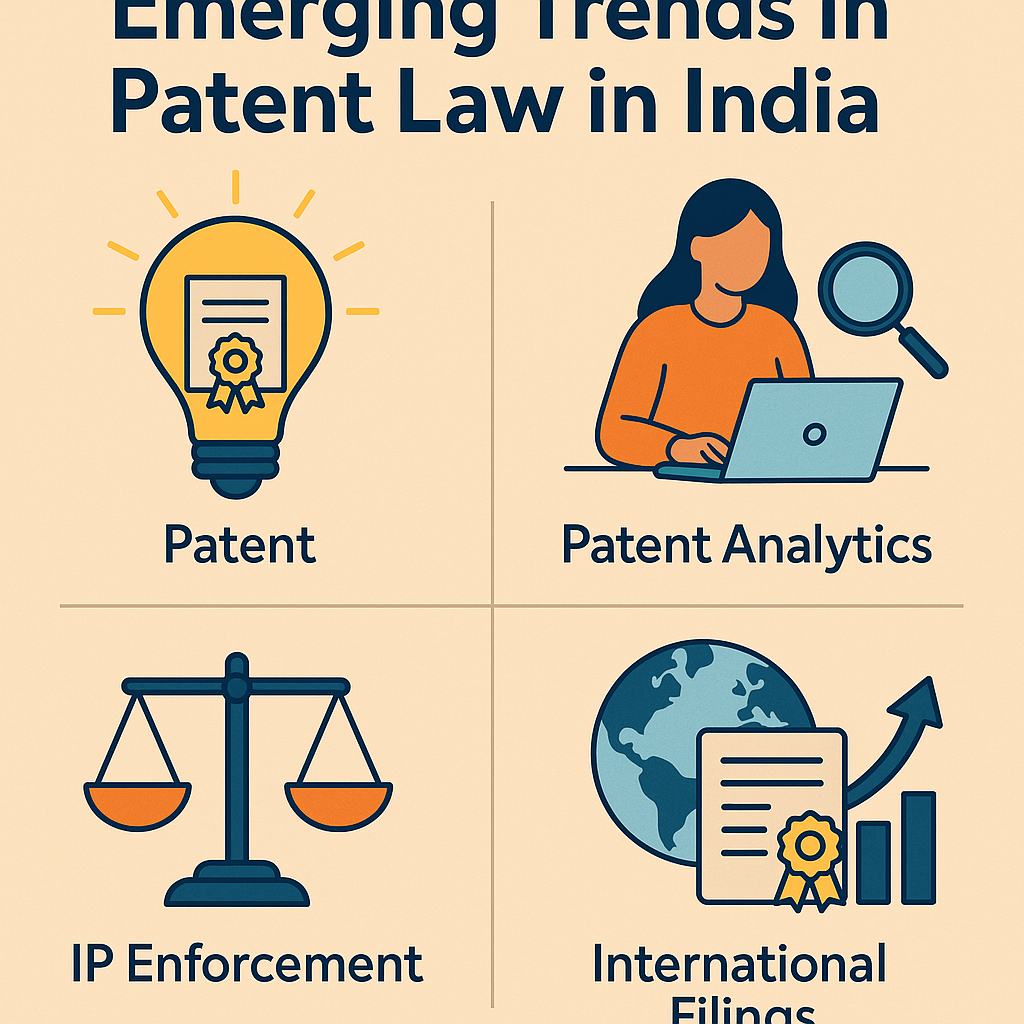
India’s patent landscape is also increasingly influenced by globalisation, international trade negotiations, and cross-border innovation strategies. With India ranking among the top global filers of patents and increasing outbound filings through the Patent Cooperation Treaty (PCT), the country is transitioning from an IP-consumption economy to an IP-producing jurisdiction (Council on Energy, Environment & Water, 2025). Policies such as Startup India and Atmanirbhar Bharat have encouraged domestic companies to adopt patent-based business strategies, turning intellectual property into a core commercial asset influencing investment, valuation, mergers, and global competitiveness. This shift is particularly visible in pharmaceutical research, artificial intelligence hardware, agricultural biotechnology, and space technology. However, harmonising domestic policy with TRIPS obligations and navigating pressure from developed economies to adopt TRIPS-plus enforcement remains a delicate balancing act.
Finally, the escalation of patent litigation reflects a maturing intellectual property ecosystem. Courts, particularly the Delhi High Court Intellectual Property Division (IPD), have strengthened judicial consistency, evidentiary standards, and scientific expertise (IPWatchdog, 2024). Litigation is increasingly used strategically—both as a defensive mechanism against infringement and as a competitive market-entry barrier. Additionally, the rise of patent valuation, licensing negotiations, standard-essential patents, and technology transfer partnerships demonstrates that patents are no longer merely legal rights but economic leverage tools embedded within business models.
In conclusion, emerging trends in Indian patent law reflect an evolving ecosystem shaped by technological growth, global interaction, and ethical questions surrounding innovation access. India’s patent regime is transitioning toward faster examinations, AI-driven policy discussions, growing green-tech protection, broader compulsory licensing interpretations, and intensified litigation practices. As India continues to balance innovation incentives with public welfare commitments, the future of patent law is likely to be defined by dynamic negotiation between economic development, technological autonomy, and constitutional values of equity and access. The direction of these reforms suggests that the Indian patent ecosystem will continue evolving—not merely as a legal mechanism of innovation control, but as a cornerstone of national development, scientific sovereignty, and global technological participation.
References (APA 7th Edition)
Council on Energy, Environment & Water. (2025, May 16). Current trends in India’s patenting landscape. https://www.orfonline.org/research/current-trends-in-india-s-patenting-landscape
DrishtiIAS. (2024, March 27). Patents (Amendment) Rules, 2024. Daily Updates. https://www.drishtiias.com/daily-updates/daily-news-analysis/patents-amendment-rules-2024
International Journal of Research in Intellectual Law. (2023, December). Compulsory licensing in India: Natco vs. Bayer case impact in India. https://ijirl.com/wp-content/uploads/2023/12/COMPULSORY-LICENSING-IN-INDI-NATCO-VS-BAYER-CASE-IMPACT-IN-INDIA.pdf
IPWatchdog. (2024, March 28). Understanding the 2024 amendment to India’s patents rules — in light of U.S. patent rules. https://ipwatchdog.com/2024/03/28/understanding-2024-amendment-indias-patents-rules-light-u-s-patent-rules
ParkerIP. (2025, January 22). Emerging trends in patent law: What to expect in 2025. https://www.parkerip.com/blog/emerging-trends-in-patent-law/

