Author: Abhinav Kumar
Co-Author: Jasdeep Kaur
Lovely professional University, Punjab
ABSTARCT
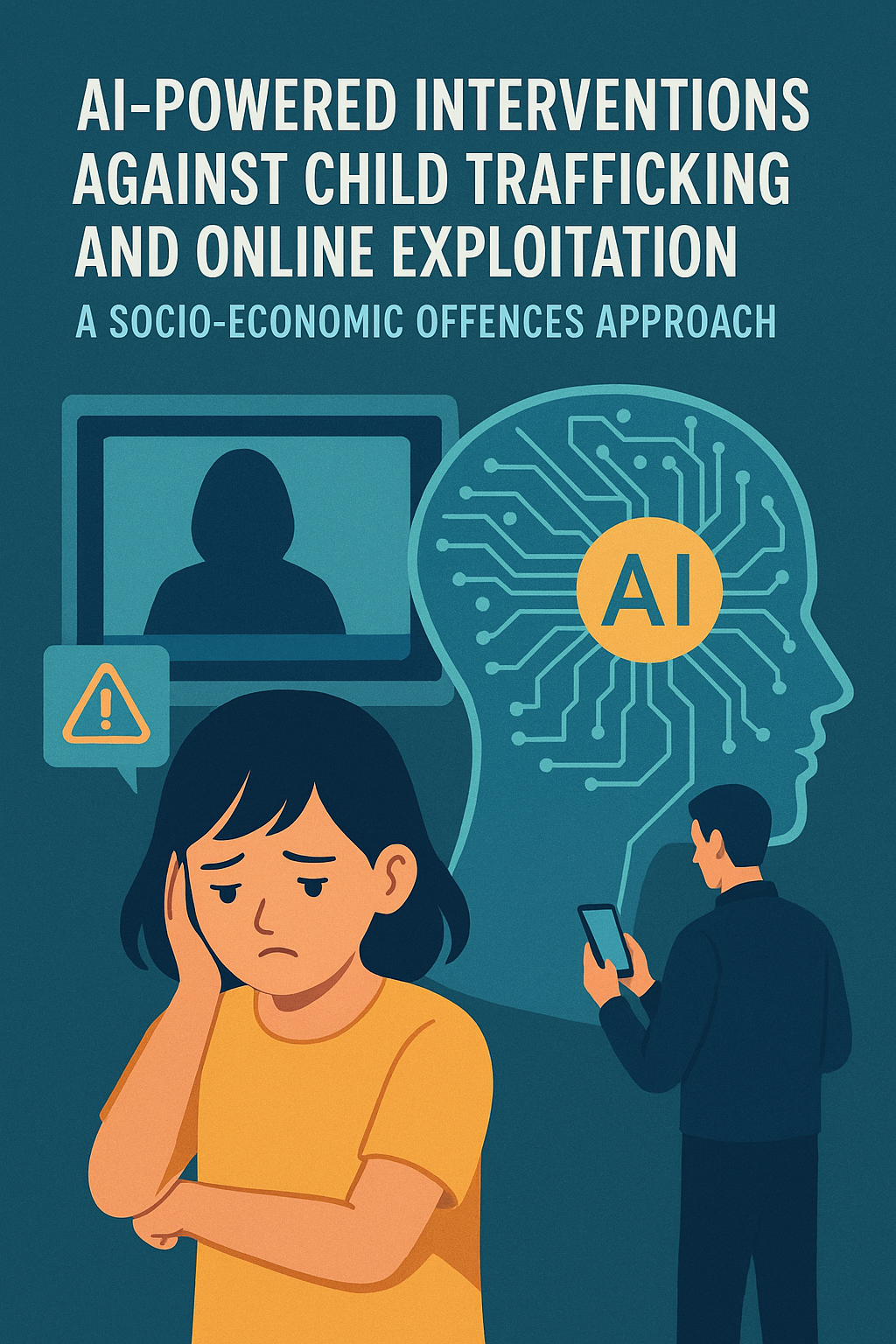
Child trafficking and online exploitation represent some of the most pressing socio-economic crimes of the 21st century, exploiting poverty, inequality, and digital vulnerabilities. The rapid expansion of the internet and social media has provided traffickers with new opportunities to recruit, groom, and exploit children, while traditional policing being reactive and resource-constrained struggles to address the transnational and technologically advanced nature of these crimes. Against this backdrop, Artificial Intelligence (AI) is emerging as a disruptive technology with significant potential to combat such offences through predictive analytics, facial recognition, content monitoring, and cross-border data analysis.
However, the integration of AI into this sensitive domain is not without challenges. Issues of privacy, algorithmic discrimination, protection of children’s rights, and constitutional safeguards raise critical concerns. This paper situates the problem within the broader framework of socio-economic offences, exploring both the opportunities and limitations of AI in addressing child trafficking and online exploitation. It examines relevant Indian legal provisions including the Bharatiya Nyaya Sanhita, 2023, the Protection of Children from Sexual Offences (POCSO) Act, 2012, and the Information Technology Act, 2000 alongside international instruments such as the UN Convention on the Rights of the Child and the Palermo Protocol. Drawing on comparative insights from jurisdictions like the European Union and the United States, the paper argues for a balanced approach: leveraging the preventive power of AI while safeguarding ethics, legality, and human rights.
KEYWORDS
Artificial Intelligence; Child Trafficking; Online Exploitation; Socio-Economic Offences; Cyber Law; Privacy; Human Rights; Law Enforcement; India; International Law.
- INTRODUCTION
Child trafficking and online exploitation are among the most disturbing socio-economic crimes of our time. They are deeply rooted in structural inequalities such as poverty, lack of education, displacement, and digital vulnerability, and are further intensified by globalization and rapid technological change. While legal frameworks like the Bharatiya Nyaya Sanhita, 2023, the Protection of Children from Sexual Offences (POCSO) Act, 2012, and the Information Technology Act, 2000, along with international instruments such as the UN Convention on the Rights of the Child and the Palermo Protocol, provide a foundation for action, enforcement remains largely reactive and fragmented. Traffickers exploit loopholes, hiding behind digital anonymity, encrypted networks, and even cryptocurrencies, making detection and prosecution a significant challenge.
In this setting, Artificial Intelligence (AI) presents transformative possibilities. It offers the chance to move from reactive interventions to proactive detection through tools like predictive analytics, facial recognition, natural language processing, and big data surveillance. Such technologies have already shown success in global initiatives, including AI-powered online abuse detection programs run by Europol. However, the integration of AI into combating child exploitation brings with it a host of ethical, legal, and human rights concerns—ranging from privacy violations and algorithmic bias to accountability and safeguarding children’s rights.
This paper critically examines how AI can be applied to address child trafficking and online exploitation as socio-economic crimes. It situates the analysis within both Indian and international legal frameworks, draws comparisons with global models, and proposes recommendations for integrating AI into law enforcement in a manner that is effective, responsible, and grounded in human rights.
- CONCEPTUAL FRAMEWORK
Socio-economic offences represent a unique category of crimes that extend beyond individual harm, striking at the very foundation of a society’s social and economic order. These crimes are often driven by financial gain, exploit systemic weaknesses, and produce wide-ranging social consequences. In Mafatlal Industries Ltd. v. Union of India, the Supreme Court of India observed that socio-economic crimes are often more damaging than conventional offences. Their profit-driven nature, compounded by poverty and inequality, leaves long-lasting scars on the social fabric.[1] Child trafficking and online exploitation clearly exemplify this category, as they not only victimize individuals but also erode trust in institutions and disproportionately target marginalized populations.
Under Indian law, trafficking is criminalized through several provisions. Section 143 of the Bharatiya Nyaya Sanhita, 2023 (formerly Section 370 of the IPC, 1860) defines trafficking as the recruitment, transport, harboring, or receipt of individuals through threats, force, or coercion for purposes of exploitation. The Protection of Children from Sexual Offences (POCSO) Act, 2012 supplements this by addressing child-specific sexual exploitation, while the Juvenile Justice Act reinforces protection mechanisms. On an international level, instruments like the UN Convention on the Rights of the Child (UNCRC) and the Palermo Protocol obligate states to criminalize trafficking and ensure safeguards for children, especially in cross-border contexts.[2]
With rising internet penetration, online exploitation has emerged as a parallel and equally alarming dimension of trafficking. It manifests through child pornography, grooming, live-streamed abuse, and the illicit trade of content on the dark web. In India, the Information Technology Act, 2000, particularly Sections 67B and 69A, provides mechanisms to punish and regulate the publication, transmission, and access of child sexual abuse material.
Artificial Intelligence (AI) intersects with these offences by offering innovative tools for prevention and disruption. Natural Language Processing (NLP), for instance, can detect grooming behavior in chat rooms, while facial recognition and deep learning technologies can help trace missing children both online and offline[3]. However, framing trafficking and exploitation as socio-economic crimes also reminds us that the legal response should go beyond punitive measures. Structural interventions that tackle root causes such as poverty, digital illiteracy, and weak enforcement are essential for meaningful change.
- RESEARCH OBJECTIVES
This paper seeks to critically explore the intersection of Artificial Intelligence (AI) and child protection, with a specific focus on trafficking and online exploitation as socio-economic crimes. The objectives are both analytical and prescriptive, aiming to situate the discussion in an Indian legal framework while drawing insights from global practices.
The key research objectives are:
- To examine child trafficking and online exploitation within the category of socio-economic offences and identify their structural causes.
- To analyze the role of AI in detecting, preventing, and combating these crimes, while highlighting its potential and limitations.
- To evaluate Indian legal frameworks (such as the BNS, POCSO Act, IT Act) considering international instruments (UNCRC, Palermo Protocol) and global best practices.
- To assess the ethical, legal, and human rights challenges posed using AI in sensitive areas like child protection.
- To propose recommendations for integrating AI into law enforcement in a balanced way that ensures effectiveness while safeguarding constitutional and human rights.
4. RESEARCH METHODOLOGY
This study adopts a doctrinal and qualitative research design, relying primarily on secondary sources such as statutes, case law, international conventions, government reports, academic writings, and institutional publications from bodies like Europol, UNICEF, and the NCRB. The doctrinal approach allows for a close analysis of existing laws, judicial interpretations, and international frameworks dealing with child trafficking, online exploitation, and the application of Artificial Intelligence (AI) in combating these offences.
A comparative legal perspective is also included, contrasting the approaches of India, the European Union, and the United States in integrating AI into anti-trafficking mechanisms. This comparison highlights both best practices and contextual challenges, offering lessons for Indian reforms.
Given the novelty of AI in law enforcement, the research further integrates interdisciplinary insights from technology law, criminology, and human rights scholarship. Technical papers on AI applications such as predictive analytics, natural language processing, and facial recognition bridge the gap between technological advancement and regulatory responses.
The methodology is largely qualitative, though it also employs descriptive statistics (such as NCRB data and global trafficking statistics) to situate child trafficking as a socio-economic crime. No fieldwork was conducted, owing to the ethical sensitivities and risks of working with vulnerable groups such as trafficked children.
By combining doctrinal, comparative, and interdisciplinary methods, the study evaluates both the potential and risks of using AI against child trafficking, while keeping the analysis rooted in legal, ethical, and human rights considerations.
5. RESEARCH SCOPE AND LIMITATIONS
The scope of this research lies primarily in the legal and policy dimensions of using AI to combat child trafficking and online exploitation, analyzed through the lens of socio-economic offences. While the paper adopts a global outlook, its primary focus is the Indian legal system, supplemented by references to the European Union and United States.
The research reviews statutory provisions, judicial precedents, and institutional measures related to trafficking, online exploitation, and AI-based enforcement. Insights from technology, criminology, and human rights are included to contextualize the socio-economic and ethical aspects.
However, the study faces certain limitations:
- It relies heavily on secondary data from government reports, NCRB statistics, and institutional publications, which may not fully capture the problem of underreporting in child trafficking cases.
- The rapidly evolving nature of AI means the analysis is confined to existing applications and may quickly become outdated with new developments.
- Ethical concerns prevent empirical fieldwork or direct engagement with survivors and enforcement authorities.
- The comparative analysis is selective, focusing on key jurisdictions relevant to India, rather than providing a comprehensive global survey.
Despite these constraints, the study offers a balanced doctrinal, comparative, and interdisciplinary evaluation that contributes meaningfully to debates on AI’s role in combating trafficking and online exploitation.
6. LITERATURE REVIEW
Existing scholarship on AI and law enforcement provides valuable insights, particularly from studies on Artificial Intelligence in Anti-Money Laundering (AML). Much of the literature recognizes that traditional, rule-based compliance systems such as Know Your Customer (KYC) norms and suspicious transaction reporting are insufficient to address the complexity of modern financial crimes.
Researchers argue that AI-driven systems including machine learning, natural language processing, and anomaly detection are better equipped to identify hidden patterns in financial crimes, adapt to new laundering methods, and reduce false positives in compliance checks. Some studies emphasize that AI enhances real-time monitoring of suspicious activities, especially in cross-border contexts and crimes involving cryptocurrencies.
At the same time, scholars raise concerns about AI: lack of transparency in algorithms, risks of bias in automated decision-making, and the ethical implications of surveillance-driven enforcement. Empirical research suggests that while AI is more adaptable than traditional systems, regulatory uncertainty and ethical dilemmas remain significant barriers to adoption.
The literature thus points toward a central tension: while AI holds immense promise for crime prevention and enforcement, its deployment must be balanced with principles of accountability, transparency, and compliance with both domestic and international legal safeguards.
7. LEGAL AND POLICY FRAMEWORK
7.1 Indian Legal Framework
India has established a multi-layered legal framework to address child trafficking and online exploitation, but enforcement gaps remain.
- Bharatiya Nyaya Sanhita, 2023 (BNS): Section 143 criminalizes human trafficking, prescribing stringent penalties for offences involving children.[4]
- Protection of Children from Sexual Offences (POCSO) Act, 2012: Specifically addresses crimes such as sexual assault, grooming, and child pornography.[5]
- Information Technology Act, 2000: Sections 67B and 69A criminalize the publication, transmission, and access of Child Sexual Abuse Material (CSAM).[6]
Despite these provisions, implementation challenges persist. Cybercrime cells remain underfunded, institutional coordination between central and state agencies is inconsistent, and traffickers often exploit technological anonymity faster than law enforcement can respond.
7.2 International Legal Instruments
Because trafficking and online exploitation are inherently global in nature, they are governed by a mix of binding and non-binding international frameworks:
- UN Convention on the Rights of the Child (UNCRC): Obligates states to protect children from all forms of exploitation.[7]
- Palermo Protocol (2000): Expands anti-trafficking obligations to include digital dimensions, emphasizing transnational cooperation and harmonized criminalization.[8]
Together, these instruments complement national legislation, pushing for stronger cross-border collaboration in tackling trafficking and exploitation in the digital age.
7.3 Comparative Legal Framework: India vs. EU vs. US
| Aspect | India | European Union (EU) | United States (US) |
| Key Laws | – Bharatiya Nyaya Sanhita, 2023 (Sec. 143 – trafficking)- POCSO Act, 2012 (child sexual offences, grooming, pornography)- IT Act, 2000 (Secs. 67B, 69A – CSAM) | – Directive 2011/93/EU on combating child sexual abuse & exploitation- GDPR (privacy and data safeguards)- Europol cybercrime regulations | – Trafficking Victims Protection Act (TVPA)– PROTECT Our Children Act– Federal & state anti-trafficking statutes |
| Scope of Crimes | Focus on trafficking, CSAM, grooming, and online exploitation | Covers grooming, CSAM, live-streamed abuse, cross-border exploitation | Broad scope: trafficking, CSAM, grooming, online enticement, live-stream abuse |
| Enforcement Bodies | – NCRB- Cyber Crime Cells (state police)- NCPCR (child rights body) | – Europol (cybercrime units)- European Cybercrime Centre (EC3)- National authorities in member states | – NCMEC (National Center for Missing & Exploited Children)- FBI, Homeland Security Investigations (HSI)- Department of Justice (DOJ) |
| Use of AI/Tech | Limited adoption, experimental AI projects; resource and capacity challenges | Strong AI integration: Europol’s AI-based abuse detection, predictive monitoring of online grooming | Advanced AI tools: facial recognition, predictive analytics, CSAM detection (PhotoDNA, AI filters) |
| Human Rights & Privacy Safeguards | Emerging framework (Digital Personal Data Protection Act, 2023) but not fully integrated with anti-trafficking measures | Strong privacy protections under GDPR; AI use is monitored against rights safeguards | Balance between law enforcement and civil liberties; debates on surveillance but strong victim protection mechanisms |
| International Collaboration | Participation in UNCRC, Palermo Protocol; bilateral agreements, but limited real-time coordination | Strong transnational mechanisms through Europol and EU-wide databases | Extensive global partnerships via INTERPOL, bilateral treaties, and information-sharing agreements |
| Challenges | – Under-resourced cyber units- Gaps in inter-agency coordination- Slow AI integration | – Balancing GDPR privacy with law enforcement- Varying implementation among member states | – Privacy concerns over surveillance- Risk of algorithm bias in AI enforcement |
8. CHILD TRAFFICKING AND ONLINE EXPLOITATION: A SOCIO-ECONOMIC OFFENCE PERSPECTIVE
In India, the National Crime Records Bureau (NCRB) has been reporting alarming statistics: over 30,000 children were officially registered as trafficked between 2017 and 2022, with a sizeable number subjected to labour exploitation, sexual exploitation, or both. However, official figures remain the tip of the iceberg. Trafficking is largely an underground crime, and official numbers are often underreported due to weak law enforcement, corruption, stigma, and fear of retaliation[9].
The online dimension aggravates this invisibility. Exploitation flourishes through parallel economies on the dark web, where perpetrators use encrypted messaging platforms, anonymous forums, and cryptocurrency transactions to evade detection. These tools create barriers for law enforcement, making it increasingly difficult to trace offenders and safeguard vulnerable children.[10]
From a normative perspective, framing child trafficking and online exploitation as socio-economic offences shifts the policy approach away from purely punitive measures toward a preventive and holistic framework.[11] This means integrating economic development, social protection, digital literacy, and the deployment of advanced technologies like AI into anti-trafficking strategies. By recognizing trafficking as both a crime and a socio-economic phenomenon, policymakers can better address the root causes (poverty, migration, inequality) and the modern enablers (internet, digital finance, cyber anonymity) simultaneously.[12]
9. USE OF ARTIFICIAL INTELLIGENCE IN COMBATING CHILD TRAFFICKING AND ONLINE EXPLOITATION
Artificial Intelligence (AI) has emerged as a transformative tool in combating transnational, technology-driven, and socio-economically entrenched crimes like child trafficking and online exploitation. Traditional policing systems hampered by limited manpower, reactive approaches, and bureaucratic delays are often ineffective in addressing the speed, scale, and sophistication of these crimes. [13]AI, however, provides innovative capabilities for predictive analytics, biometric identification, natural language processing (NLP), and large-scale data monitoring, thereby offering a more proactive enforcement model[14].
9.1 Predictive Policing and Risk Detection
AI-driven predictive policing systems can analyze large-scale datasets such as missing children reports, migration trends, social media patterns, and past trafficking hotspots to forecast risk-prone locations and individuals.[15]
- Case Example (US): The National Center for Missing and Exploited Children (NCMEC) uses machine learning algorithms to process millions of cyber tips annually, helping law enforcement prioritize high-risk cases.
- Indian Example: TrackChild and Khoya-Paya portals enable real-time tracking of missing children by integrating police, child welfare committees, and citizens, though their predictive capacities remain underdeveloped.
9.2 Biometric and Facial Recognition
AI-powered facial recognition technologies (FRT) and biometric systems assist in identifying missing children and detecting Child Sexual Abuse Material (CSAM) online.
- Case Example (India): In 2018, the Delhi Police used FRT to identify nearly 3,000 missing children within just a few days.
- Case Example (Global): Microsoft’s PhotoDNA employs AI hashing to identify and remove CSAM across digital platforms[16].
However, these applications raise critical concerns about privacy, surveillance overreach, false positives, and potential misuse, requiring strong legal safeguards.
9.3 Online Content Monitoring and Dark Web Investigations
AI applications in natural language processing (NLP), image recognition, and blockchain analytics are critical in monitoring encrypted platforms, dark web forums, and crypto transactions that traffickers exploit.
- Europol’s “Trace an Object” Program: Uses crowdsourced AI analysis of online images linked to child exploitation, helping identify more than 30,000 victims.
- Interpol’s ICSE Database: An AI-powered image matching tool that has successfully identified 30,000+ victims worldwide.
- Europol’s iCOP AI Tool: Detects new CSAM on peer-to-peer networks, enhancing international enforcement[17].
9.4 Cross-Border Cooperation and Data Analytics
Since trafficking is a transnational offence, AI facilitates global cooperation through data-sharing platforms and joint investigative tools.
- Project VIC (US + International): A global public-private partnership using AI hashing technologies to categorize CSAM, eliminate duplication in investigations, and accelerate victim rescue across jurisdictions[18].
- Blockchain Analytics: AI can trace cryptocurrency transactions used to fund or mask trafficking operations, thereby closing loopholes in cyber-financing[19].
9.5 Limitations and Concerns
Despite its promise, AI in anti-trafficking enforcement raises ethical, legal, and operational concerns:
- Algorithmic Bias: AI systems risk disproportionately targeting marginalized communities, reinforcing social inequalities.
- Privacy Risks: Overreliance on surveillance technologies can undermine Article 21 (Right to Privacy) in India, as upheld in Puttaswamy v. Union of India.
- Lack of Transparency: AI decision-making is often opaque, raising questions of accountability and due process.
- Over-Criminalization: Without safeguards, AI could become a tool of mass surveillance and over-policing, undermining child welfare rather than protecting it[20].
Thus, while AI strengthens the State’s ability to combat trafficking, it must be carefully balanced with constitutional rights, human dignity, and the welfare principle, ensuring its deployment is both effective and ethically sound.
10. ETHICAL, LEGAL, AND HUMAN RIGHTS CONCERNS
The use of Artificial Intelligence (AI) to combat child trafficking and online exploitation is far from neutral. While AI offers unprecedented capabilities for law enforcement, it also introduces critical ethical, legal, and human rights challenges. These concerns are particularly acute in crimes involving children, where misuse of technology can exacerbate victimization rather than prevent it.
10.1 Privacy and Surveillance
AI-driven tools such as online monitoring, facial recognition, and predictive policing rely on mass data collection, which can intrude into individuals’ private lives. In Justice K.S. Puttaswamy v. Union of India, the Supreme Court recognized privacy as a fundamental right under Article 21 of the Constitution. [21]Unregulated or indiscriminate use of AI may violate this right, highlighting the need for legal authorization and safeguards.
10.2 Algorithmic Bias and Discrimination
AI systems are only as unbiased as the data they are trained on. When datasets reflect historical or social biases, predictive policing and monitoring tools can disproportionately target marginalized groups, reinforcing inequality. Research in the U.S. has shown racial and socio-economic bias in AI policing systems, serving as a cautionary example for India[22].
10.3 Accountability and Transparency
AI often functions as a “black box,” making its decision-making process opaque. In criminal justice, this lack of explainability challenges accountability and the principles of due process and fair trial. Without clear guidelines for the admissibility of AI-generated evidence, its use could undermine India’s evidentiary standards.
10.4 Child Rights Safeguards
The Convention on the Rights of the Child (CRC) emphasizes that the best interests of the child must guide all interventions. Overzealous AI surveillance can inadvertently lead to stigmatization, wrongful profiling, or secondary trauma, for example, by misinterpreting innocent online behaviour as grooming[23].
10.5 Data Protection and Cybersecurity
AI systems rely on sensitive data such as biometric identifiers and communication records. Without robust legal safeguards, this data is vulnerable to misuse. Although India’s Digital Personal Data Protection Act, 2023 provides some protection, there is no AI-specific regulatory framework governing law enforcement, leaving significant gaps in cybersecurity and privacy protection[24].
11. COMPARATIVE JURISPRUDENCE
The adoption of AI in anti-trafficking initiatives varies across jurisdictions, influenced by national legal culture, enforcement priorities, and technological readiness. While international instruments such as the Palermo Protocol and CRC set minimum obligations, their implementation differs significantly.
11.1 United States
The Trafficking Victims Protection Act (TVPA) and the PROTECT Our Children Act provide a legal framework to combat child trafficking. Federal agencies like the FBI and DHS use AI-based tools, including predictive analytics and facial recognition, to identify trafficking networks on the dark web. Partnerships with tech companies such as Thorn and Microsoft PhotoDNA have enhanced detection and evidence-gathering. Courts generally uphold such digital surveillance when balanced against the state interest in child protection, though Fourth Amendment concerns regarding privacy sometimes arise[25].
11.2 European Union
The EU takes a rights-based approach, prioritizing child protection and privacy under the GDPR. The Directive 2011/36/EU mandates victim-centered strategies but allows AI-assisted surveillance for cross-border tracking of human trafficking[26]. Initiatives like Europol’s AI-based image analysis have successfully identified terabytes of CSAM, though European courts remain vigilant about privacy and constitutional safeguards, particularly in Germany and France[27].
11.3 United Kingdom
Under the Modern Slavery Act, 2015, criminal responsibility for traffickers is complemented by corporate transparency obligations. The National Crime Agency (NCA) uses AI to analyze cryptocurrency transactions linked to exploitation and employs AI-based content moderation tools to identify online grooming. Courts generally support preemptive digital evidence when it is necessary to protect children[28].
11.4 Singapore
Singapore’s Prevention of Human Trafficking Act, 2014 is supplemented by the Monetary Authority of Singapore’s (MAS) AI-enabled financial surveillance, which tracks suspicious transactions potentially linked to trafficking[29]. The government’s approach combines technological pragmatism with strong regulatory oversight, creating early-warning systems to detect exploitation while respecting legal standards[30].
11.5 India
India has deployed AI tools through NCRB and cybercrime bureaus to monitor internet content and assist investigations under POCSO, IT Act, and IPC provisions. Early judicial recognition, such as in State of Tamil Nadu v. Suhas Katti[31], indicates growing acceptance of AI-based evidence. However, India’s AI integration remains fragmented and pilot-based, constrained by privacy concerns, infrastructure gaps, and limited coordination.
11.6 Comparative Insights
- Common Law Jurisdictions (U.S., U.K., India): Emphasize operational effectiveness and preemptive use of AI, with varying attention to privacy protections.
- Civil Law / Rights-Based Jurisdictions (EU): Prioritize a balance between innovation and stringent data protection standards.
- Hybrid Models (Singapore): Demonstrate a pragmatic approach combining state oversight, technological integration, and early-warning financial systems.
The diversity in global practice underscores the need for integrated international collaboration and context-sensitive policies in the digital age, where child trafficking and online exploitation are inherently cross-border crimes.
12. CASE LAWS
The fight against child trafficking and online exploitation in India and abroad is increasingly being shaped by judicial interventions that interpret statutory provisions, protect child rights, and guide law enforcement in leveraging technology responsibly. Courts have recognized the socio-economic dimensions of trafficking, the vulnerabilities of children in digital spaces, and the need for proactive measures. While comparative jurisprudence highlights how different countries legislate and regulate AI in tackling child trafficking and online exploitation, real-world case studies reveal both the successes and limitations of AI deployment. These cases demonstrate that AI improves detection efficiency, but institutional responsibility, human oversight, and ethical safeguards remain essential.
12.1 Europol’s CSAM Project
Europol’s Innovation Lab developed AI-driven image analysis systems to scan large volumes of online data and identify child sexual abuse material (CSAM). By clustering similar images, investigators can work faster to track offenders and rescue victims. However, algorithmic errors can misclassify non-exploitative content, raising GDPR compliance and proportionality concerns. According to Europol’s 2021 report, the system reduced investigation time by 60% in certain operations[32].
12.2 Thorn Spotlight Tool – United States
The NGO Thorn created the AI-powered “Spotlight” tool, which crawls online classifieds and dark web forums to detect trafficking victims. Thorn reported in 2020 that spotlight helped law enforcement reduce victim identification time by 65%, leading to the rescue of hundreds of children. Yet, some instances, such as United States v. Ackerman, raised constitutional questions about public-private partnerships and the legal defenses available in AI-assisted investigations[33].
12.3 United Kingdom – Cryptocurrency Tracing
The UK’s National Crime Agency (NCA) uses AI to trace cryptocurrency transactions linked to online exploitation. In R v. Wong, the Court of Appeal confirmed the admissibility of AI-assisted transaction monitoring, with 70% reduction in financial investigation backlogs. This case illustrates AI’s potential in tracking financial flows related to trafficking, while highlighting ongoing privacy and proportionality concerns in financial regulation[34].
12.4 India – NCRB Pilot on Online Exploitation Detection
In 2022, India’s National Crime Records Bureau (NCRB) piloted an AI system to detect child sexual exploitation material (CSEM) online, in collaboration with state cybercrime agencies and Microsoft’s PhotoDNA. Within the first year, it assisted in tracing offenders in over 200 cases across five states, though it faced challenges like limited infrastructure, insufficient trained personnel, and concerns over over-surveillance[35].
12.5 Singapore – FinTech Intervention in Trafficking
In 2019, the Monetary Authority of Singapore (MAS) partnered with FinTech companies to monitor suspicious remittances using AI, identifying online exploitation networks across Southeast Asia. While successful prosecutions followed, Singapore’s judiciary emphasized that AI-generated warnings cannot replace independent judicial evidence, reflecting a balanced approach where technology supports, but does not replace, legal oversight[36].
- Bachpan Bachao Andolan v. Union of India (2011)
- The Supreme Court emphasized the need for proactive monitoring and rescue mechanisms for trafficked children.
- It underscored the responsibility of both central and state governments to ensure coordination among police, child welfare committees, and NGOs.
- Although AI was not discussed, the judgment laid the groundwork for technological interventions in monitoring missing children and preventing trafficking[37].
- Anuradha Bhasin v. Union of India (2020)
- The Court reiterated that access to information and communication technologies is essential, especially for vulnerable populations.
- This judgment provides a constitutional basis for using digital tools, including AI-based monitoring, while protecting citizens’ rights[38].
- State of Tamil Nadu v. Suhas Katti (Cyber Child Exploitation, 2004)
- One of the earliest cases highlighting online child pornography and grooming, prompting the use of IT Act provisions (Sec 67B).
- It emphasizes the judiciary’s recognition of digital mediums as a new vector for exploitation, a domain where AI can be applied for detection and prevention[39].
13. INTERNATIONAL JUDICIAL TRENDS
- European Court of Human Rights (ECtHR) – Satakunnan Markkinapörssi Oy v. Finland (2017)
- The court highlighted the balance between state surveillance for child protection and privacy rights.
- This supports the notion that AI-based monitoring must operate under strict ethical and legal frameworks, avoiding undue infringement on personal freedoms.
- United States – United States v. Ulbricht (2015)
- The case of the Silk Road dark web marketplace demonstrated the challenges of online illegal trade, including child exploitation.
- Law enforcement utilized digital forensic analysis, which now can be enhanced using AI for monitoring, detection, and tracing illicit networks.
- UN Committee on the Rights of the Child – General Comment No. 25 (2021)
- Recognizes the digital environment as a critical space for child rights protection, urging states to adopt innovative technological measures while ensuring privacy, consent, and safety.
14. OBSERVATIONS FROM JUDICIAL TRENDS
- Proactive Intervention: Courts increasingly support preventive measures, paving the way for AI integration into law enforcement.
- Digital Recognition: Legal systems recognize online exploitation as a significant vector of trafficking, legitimizing the use of digital tools and AI.
- Rights Balance: Both domestic and international jurisprudence stress balancing surveillance with privacy and human rights, a key concern in AI adoption.
- Coordination Imperative: Judgments emphasize multi-agency cooperation, which can be facilitated through AI-based data analytics, risk mapping, and cross-border information sharing.
15. RECOMMENDATIONS AND POLICY IMPLICATIONS
The convergence of AI technology, child protection, and socio-economic crime prevention presents an opportunity to modernize India’s approach to trafficking and online exploitation, but it must be carefully balanced with ethical, legal, and human rights considerations. Based on the preceding analysis, the following recommendations are proposed:
- Accountability and Transparency: AI models must be explainable, auditable, and accountable to prevent misuse.
- Global Harmonization of Standards: International collaboration is essential to develop uniform AI practices, avoiding regulatory loopholes.
- Human-in-the-Loop Approach: AI should assist, not replace human judgment. Final decisions must remain with trained officials.
- Capacity-Building and Training: Institutions and regulators need to invest in technical expertise to monitor, assess, and regulate AI tools.
- Data Governance and Privacy: Strong safeguards should protect sensitive data while enabling effective AI-driven monitoring.
- Collaborative Platforms: Governments, regulators, financial institutions, and tech providers should establish joint task forces and sandboxes to test AI solutions safely.
- Ethical Implementation: AI must be fair, unbiased, and compliant with human rights, ensuring that anti-trafficking efforts do not infringe on individual liberties.
A robust AI policy must integrate legislative clarity, institutional oversight, technical reliability, community engagement, and socio-economic prevention, address the root causes of trafficking while respect rights and privacy.
Strengthening Legal and Regulatory Frameworks
- Integrate AI Guidelines into Existing Laws: Amend statutes such as the Bharatiya Nyaya Sanhita, 2023, POCSO Act, 2012, and IT Act, 2000 to explicitly recognize AI tools in detection, prevention, and investigation, while ensuring constitutional compliance with privacy and due process.
- Codify Ethical Standards for AI Use: Introduce legal frameworks inspired by the EU AI Act (2021) and the Budapest Convention, specifying limits, accountability mechanisms, and monitoring of AI systems in child protection.
- National AI Task Force for Child Protection: Establish a multi-stakeholder body including law enforcement, child welfare experts, technologists, and human rights advocates to oversee responsible AI deployment.
Technological Integration and Capacity Building
- Enhance AI-Driven Predictive Policing: Scale up initiatives like TrackChild and incorporate machine learning algorithms to identify high-risk areas, patterns, and vulnerable populations.
- Expand Facial Recognition and Biometric Databases: Integrate AI-powered FRT in coordination with missing children registries, while implementing strict safeguards to prevent misuse.
- Dark Web and Crypto Monitoring: Utilize AI and blockchain analytics to track trafficking operations and transactions while ensuring cross-agency collaboration at national and international levels.
- Cybercrime Cell Capacity Building: Provide specialized training, resources, and AI tools to police, forensic experts, and child protection agencies for effective deployment.
Cross-Border Collaboration
- Data Sharing Protocols: Establish secure, standardized frameworks for international cooperation with INTERPOL, Europol, and bilateral partners, leveraging AI to identify patterns and accelerate rescues.
- Global AI Taskforce Participation: Engage with international initiatives to share best practices on AI ethics, algorithm transparency, and child protection standards.
Socio-Economic and Preventive Measures
- Digital Literacy and Awareness Programs: Educate children, parents, and communities about online risks, grooming tactics, and reporting mechanisms.
- Economic and Social Support: Address the root socio-economic drivers of trafficking, such as poverty, unemployment, and gender inequality, through social protection schemes and access to quality education.
- Victim-Centric AI Applications: Ensure that AI systems prioritize child welfare, rehabilitation, and privacy, rather than only focusing on punitive measures.
Ethical Oversight and Accountability
- Algorithmic Transparency: AI tools must be auditable, with clear documentation of how decisions are made to prevent bias and discrimination.
- Regular Ethical Reviews: Conduct independent audits to ensure AI deployment respects human rights, constitutional guarantees, and ethical norms.
- Community Participation: Involve civil society, NGOs, and child welfare experts in shaping AI policies and reviewing its impact.
16. CONCLUSION
The integration of Artificial Intelligence (AI) into anti-trafficking and anti-money laundering systems presents both opportunities and challenges. AI has proven capable of detecting complex patterns, minimizing false positives, and enhancing cross-border monitoring. However, concerns regarding algorithmic bias, privacy violations, and transparency persist.
Comparative analysis shows that countries like the United States, European Union, and Singapore have advanced regulatory frameworks aligned with technological developments, while India is still in the initial stages of AI adoption. Case studies highlight that, although AI enhances compliance and investigative efficiency, ultimate responsibility rests with institutions and regulators, and human oversight is indispensable.
The future requires a harmonized international framework, emphasizing transparency, accountability, and rights-respecting AI deployment. By adopting a balanced, multi-dimensional approach, India and other nations can leverage AI’s potential to protect children and combat trafficking without compromising constitutional values and human rights.
17. REFERENCES
• Bank Secrecy Act, 31 U.S.C. §§ 5311–5330 (2020).
• USA PATRIOT Act, Pub. L. No. 107–56, 115 Stat. 272 (2001).
• Directive (EU) 2018/843 of the European Parliament and of the Council of 30 May
2018, 2018 O.J. (L 156) 43.
• Financial Crimes Enforcement Network (FinCEN), Innovation Hours Program
Guidance (2019).
• Financial Conduct Authority
(U.K.), FCA TechSprints: Using Technology to Improve
Financial Services (2020).
• Monetary Authority of Singapore (MAS), Regulatory Sandbox Guidelines (2021).
• Reserve Bank of India (RBI), Report of the Working Group on Digital Lending (2021).
• Prevention of Money Laundering Act, No. 15 of 2003, INDIA CODE (2003).
• United States v. Wachovia Bank, N.A., Deferred Prosecution Agreement, Case No. 10-
20165-CR (S.D. Fla. 2010).
• Zetzsche, Dirk Andreas et al., Artificial Intelligence in Financial Regulation and
Compliance: An Overview, 22 J. Banking Reg. 1 (2021).
• Hou, Chang, & Xin Li, Machine Learning for Money Laundering Detection: A
Comparative Study, 14 IEEE Trans. Knowledge & Data Eng. 1205 (2020).
• Arner, Douglas W. et al., FinTech and RegTech: Impact on Regulators and Banks, 21 J.
Banking Reg. 45 (2019).
• Danske Bank Money Laundering Case, European Parliament Briefing (2019).
• World Bank, Leveraging Artificial Intelligence to Combat Money Laundering (2020).
• FATF, Opportunities and Challenges of New Technologies for AML/CFT (2019).
[1] Mafatlal Indus. Ltd. v. Union of India, (1997) 5 SCC 536 (India).
[2] United Nations Convention on the Rights of the Child, Nov. 20, 1989, 1577 U.N.T.S. 3; Protocol to Prevent,
Suppress and Punish Trafficking in Persons, Especially Women and Children, supplementing the United Nations
Convention against Transnational Organized Crime, Nov. 15, 2000, 2237 U.N.T.S. 319.
[3] The Information Technology Act, No. 21 of 2000, §§ 67B, 69A (India).
[4] Bharatiya Nyaya Sanhita, No. 45 of 2023, § 143 (India).
[5] The Protection of Children from Sexual Offences Act, No. 32 of 2012, §§ 13–15 (India)
[6] The Information Technology Act, No. 21 of 2000, §§ 67B, 69A (India).
[7] United Nations Convention on the Rights of the Child, Nov. 20, 1989, 1577 U.N.T.S. 3.
[8] Protocol to Prevent, Suppress and Punish Trafficking in Persons, Especially Women and Children,
supplementing the United Nations Convention against Transnational Organized Crime, Nov. 15, 2000, 2237
U.N.T.S. 319.
[9] Kamala Kempadoo, Trafficking and Prostitution Reconsidered: New Perspectives on Migration, Sex Work, and
Human Rights 18 (2015).
[10] Anja Kovacs, Trafficking in the Digital Age: Challenges of Online Exploitation in India, 15 Asian J.
Criminology 112 (2021).
[11] A. Banerjee, Child Trafficking and Economic Development: A Study of South Asia, 29 Econ. & Pol. Weekly 55
(2020).
[12] Louise Shelley, Human Trafficking: A Global Perspective 33 (2010)
[13] National Crime Records Bureau, Crime in India: Statistics 2017–2022 (Gov’t of India, 2023).
[14] Saptarshi Mandal, Socio-Legal Responses to Child Trafficking in India: Rethinking Prevention Strategies, 42
Indian J. Socio-Legal Stud. 87 (2021)
[15] Europol, Internet Organised Crime Threat Assessment (2022)
[16] Nat’l Ctr. for Missing & Exploited Child., 2022 Annual Report (2023), https://www.missingkids.org
[17] Microsoft, PhotoDNA, https://www.microsoft.com/en-us/photodna (last visited Sept. 13, 2025)
[18] Project VIC International, About Us, https://www.projectvic.org (last visited Sept. 13, 2025)
[19] Ministry of Women & Child Dev., TrackChild Portal, https://trackthemissingchild.gov.in (last visited Sept. 13,
2025)
[20] INTERPOL, International Child Sexual Exploitation Database, https://www.interpol.int/en (last visited Sept.
13, 2025).
[21] Justice K.S. Puttaswamy v. Union of India, (2017) 10 SCC 1 (India)
[22] Kristian Lum & William Isaac, To Predict and Serve? 13 Significance 14 (2016)
[23] United Nations Convention on the Rights of the Child, Nov. 20, 1989, 1577 U.N.T.S. 3
[24] The Digital Personal Data Protection Act, No. 22 of 2023 (India)
[25] Protocol to Prevent, Suppress and Punish Trafficking in Persons, Especially Women and Children, Nov. 15,
2000, 2237 U.N.T.S. 319; Convention on the Rights of the Child, Nov. 20, 1989, 1577 U.N.T.S. 3
[26] See United States v. Ackerman, 831 F.3d 1292 (10th Cir. 2016).
[27] Trafficking Victims Protection Act of 2000, Pub. L. No. 106-386, 114 Stat. 1464 (2000)
[28] U.K. Home Office, Tackling Child Sexual Abuse Strategy 2021
[29] Prevention of Human Trafficking Act 2014, Act 45 of 2014 (Sing.).
[30] PROTECT Our Children Act of 2008, Pub. L. No. 110-401, 122 Stat. 4229 (2008).
[31] State of Tamil Nadu v. Suhas Katti, CC No. 4680 of 2004 (CMM Egmore, Chennai)
[32] Europol, Innovation Lab Projects, https://www.europol.europa.eu (last visited Sept. 13, 2025)
[33] 8
United States v. Ackerman, 831 F.3d 1292 (10th Cir. 2016)
[34] R v. Wong, [2020] EWCA Crim 103 (U.K.)
[35] NCRB, Pilot Projects on AI-enabled Policing (2022)
[36] Monetary Authority of Singapore, Harnessing Technology to Combat Financial Crime (2019)
[37] NCRB, Crime in India 2022: Statistics (2023)
[38] Information Technology Act, No. 21 of 2000, INDIA CODE (2000).
[39] Information Technology Act, No. 21 of 2000, INDIA CODE (2000); Protection of Children from Sexual
Offences Act, No. 32 of 2012, INDIA CODE (2012)