BY : ANAMIKA
Abstract
The digital age has transformed the creation, distribution and safeguarding of intellectual works. Innovations like intelligence, blockchain technology, cloud computing platforms, international streaming services and online commercial spaces have greatly broadened the reach of intellectual property rights (IPR) while also making their enforcement more complex. This study investigates the impact of digitalization, on IPR by analysing how technological advancements have encouraged worldwide knowledge access, enhanced creator independence and facilitated novel economic opportunities. Simultaneously it underscores the difficulties linked to this change, such as digital piracy, automated copyright enforcement, conflicts regarding AI-produced material and the ongoing division of global regulatory systems. By examining advancements, new legal controversies and current policy requirements this paper offers a clear but thorough insight into the progression of IPR in governing creativity and innovation, within today’s digital environment.
INTRODUCTION
The digital revolution has drastically transformed the essence and role of property. Historically intellectual property rights aimed to protect books, inventions, artworks and manufacturing methods. Yet the digital era has broadened these safeguards to include software, virtual items, genetic information, algorithms and numerous intangible digital innovations. The internet has revolutionized sectors by allowing immediate worldwide dissemination enabling creators to connect with extensive audiences more easily, than ever. Along with these opportunities the identical technologies have facilitated duplication and illicit distribution. Creativity has grown more collaborative, global and digitally facilitated prompting inquiries about originality, authorship and the control of digital material. As these trends develop IPR systems must evolve to accommodate forms of creation, consumption and distribution, in a connected technological landscape.
Historical Foundations of Intellectual Property Rights
Contemporary intellectual property legislation originates from the Statute of Anne (1710) which officially acknowledged authors rights over publishers and began a transition toward appreciating work as a type of personal property. Patent frameworks in Europe and the United States evolved simultaneously encouraging innovation and technological progress. Global collaboration arose with the Paris Convention of 1883 and the Berne Convention of 1886 each setting international guidelines, for safeguarding patents, trademarks and literary and artistic creations. By the 1900s emerging media like radio, film and TV broadened the range of IP safeguards significantly. The establishment of the World Intellectual Property Organization (WIPO) in 1967 along with the implementation of the TRIPS Agreement in 1995 underscored the significance of IP, in commerce. However these earlier structures were designed for an analog age. Failed to predict the intricate challenges posed by digital technologies, where materials can be replicated and distributed infinitely with minimal expense.
Digital-Era Challenges to IPR
The expansion of the internet unveiled weaknesses in conventional IPR frameworks. Digital materials can be copied flawlessly. Distributed immediately weakening the exclusivity that classic copyright frameworks depended upon. Initial peer-to-peer file-sharing services like Napster demonstrated the extent of digital piracy compelling entertainment sectors to reevaluate their distribution approaches. These challenges ultimately resulted in the development of subscription services, like Spotify and Netflix designed to provide user-friendly options to piracy. At the time digital culture shifted users from mere consumers to active producers. Memes, remixes, mashups and fan edits muddled the lines between original creations and derivatives. Social media heightened creativity and sparked debates regarding the boundaries of fair use, transformative expression and authorship, within collaborative digital environments.
Copyright and its Digital Transformation
Digital technologies have brought about difficulties in enforcing copyright. In contrast to analog duplication, which demanded materials and labor digital copying occurs instantly flawlessly and can be duplicated endlessly. Piracy networks use servers, mirror websites and VPNs to bypass controls complicating enforcement efforts. Consequently regulation has moved toward governance centered on platforms. Automated tools, like YouTube’s Content ID examine uploaded content to spot violations but algorithmic oversight frequently mistakes lawful uses hindering parody, commentary or educational material. Digital Rights Management (DRM) systems incorporated into e-books, software and streaming services limit users capacity to alter or distribute content fueling discussions, about whether copyright law ought to emphasize maximum creator control or protect user liberties and accessibility.
Patents and Technological Innovation
Patents have grown to play a role in economic rivalry within the digital market. The inclusion of software, algorithms, AI models and business methods as inventions extended the scope of patent legislation but also heightened clashes between tech firms. Companies are progressively amassing patent collections to strengthen their market power and discourage rivals. Notable battles like the Apple, vs. Samsung smartphone case demonstrate how patents influence industry patterns worldwide. Furthermore creations produced by AI novel challenges to patent systems based on the concept of human inventors. While judicial bodies globally persist in denying AI systems recognition as inventors the increase, in inventions created by machines prompts significant inquiries into whether patent legislation needs to adapt to technological advancements.
Trademarks and Digital Identity
With commerce moving into digital realms trademarks are now vital, for safeguarding brand identity and maintaining consumer confidence. The online marketplace is encountering a rising wave of products scam websites, fake profiles and cybersquatting incidents. Social media complicates brand identity protection because of influencer culture evolving digital trends and the rise of virtual items, digital avatars and metaverse branding. Businesses are progressively depending on automated detection tools and collaborations with platforms to oversee trademark usage. These changes require legal adjustments to maintain brand integrity in broad and decentralized digital settings.
Digital Piracy and Enforcement Complexities
Although vigorous enforcement measures are in place digital piracy continues unabated owing to file-sharing networks worldwide distributed hosting servers and technologies enabling anonymous browsing. Unauthorized streaming sites, cracked software archives and unlicensed IPTV offerings pose challenges to copyright frameworks worldwide. Enforcement bodies are progressively targeting intermediaries like search engines, ISPs and hosting providers. Nonetheless technological defenses, mirror sites and changing domains frequently reinstate access, to infringing materials perpetuating a continuous loop of circumvention. These intricacies highlight the challenge of governing an internet that functions internationally and, outside the bounds of legal frameworks.
Artificial Intelligence and the Redefinition of Authorship
Artificial intelligence has challenged beliefs about creativity and authorship. Machine learning models are capable of producing art, music, literature, designs and inventions with complexity raising challenging issues about what originality truly means. The swift growth of AI has sparked debates about who owns machine-created outputs the copyright implications of training datasets and the morality of utilizing copyrighted content to train AI systems. Creators and writers have frequently initiated legal actions against AI creators marking a significant milestone, in intellectual property law in the digital age. As AI increasingly obscures the boundary, between mechanical creativity, legal systems need to reevaluate the definition of authorship in a time of self-directed creation.
Data, Privacy and the Expanding Notion of IP
Personal data has become among the precious assets within the digital economy. Details, like browsing records, biometric information, location data and trends power tailored advertising, algorithmic evaluation and surveillance-based commercial strategies. Although data is not typically regarded as property its rising economic and strategic significance implies that future intellectual property systems might more often acknowledge individuals’ rights to manage their own digital personas. This shift aligns with discussions surrounding privacy consent protocols and the growing reach of surveillance capitalism.
Global Fragmentation and the Need for Harmonization
Although digital technologies are fundamentally global the application of intellectual property rights continues to be segmented by territory. Domestic regulations differ significantly regarding issues like use safe-harbor rules, data privacy responsibilities and intermediary accountability. Treaties like TRIPS set frameworks but find it difficult to adapt swiftly to fast-moving technological changes. Violations occurring across borders often exploit loopholes highlighting the need for coordinated international oversight. Yet conflicting national priorities and diverse legal approaches remain challenges, to establishing uniform worldwide norms.
Contemporary Case Studies
Recent controversies underscore the intricacies of property in the digital era. Entertainment sectors persistently suffer setbacks due to widespread streaming piracy flourishing on decentralized networks. Smartphone makers are still entangled in protracted patent disputes showcasing how rivalry in technology drives worldwide conflicts. Moreover legal actions involving AI-created art and datasets used for machine learning training highlight the friction between innovation and artistic rights. Together these instances expose struggles related to ownership, economic influence and oversight responsibilities, within the digital environment.
Advantages of IPR in the Digital Era
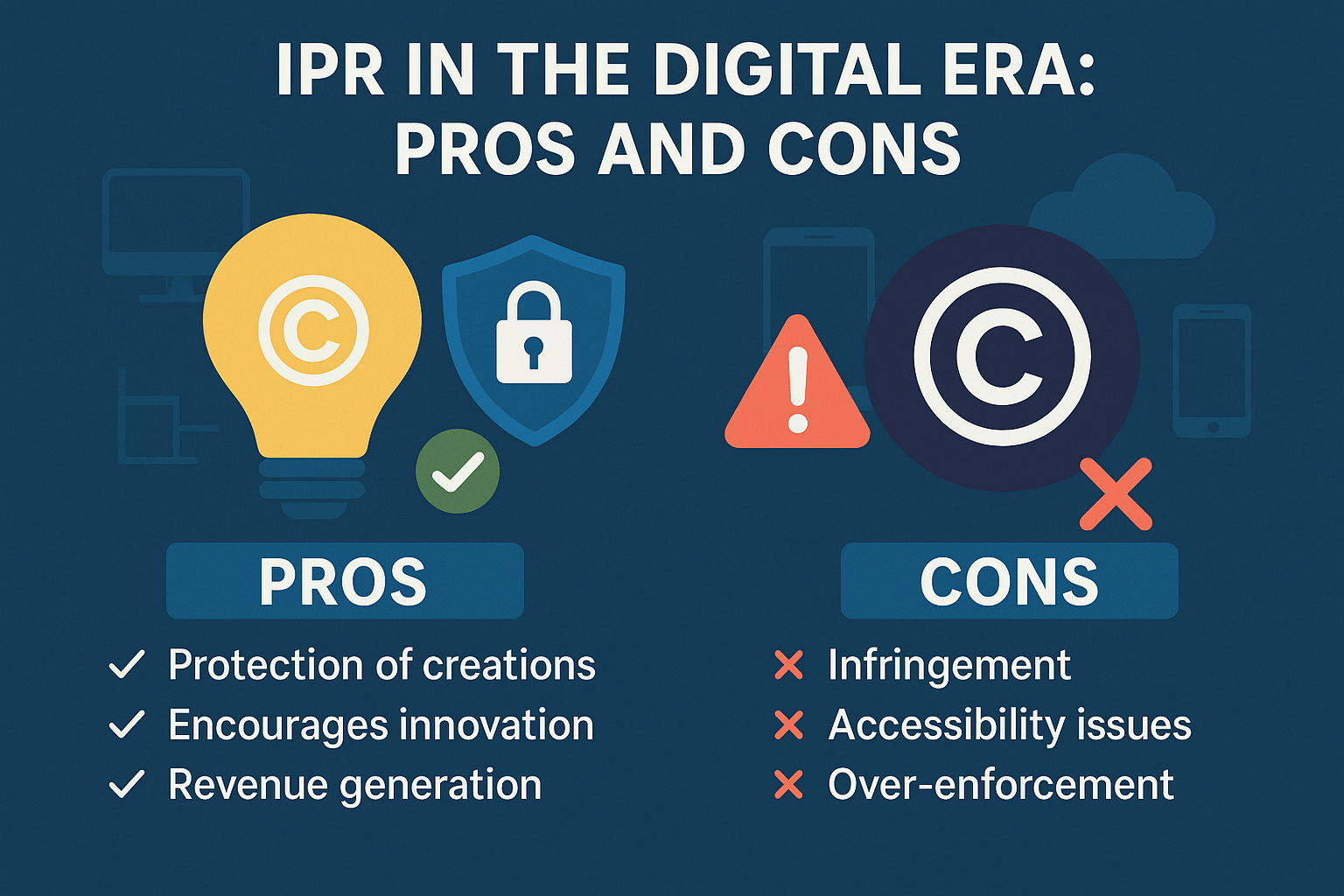
Intellectual property rights provide benefits in the digital realm. The internet grants creators unparalleled access allowing them to share and profit from their creations on a scale never seen before. Robust IP safeguards encourage motivations that drive innovation in sectors like biotechnology, artificial intelligence and digital media which demand significant funding for research and development. Advances, in technology have also enhanced licensing systems bringing automated royalty payments, micro-licensing options and fresh methods to oversee rights on platforms. Digital platforms also enable marginalized creators by providing exposure the ability to be found and legal safeguards.
Limitations and Criticisms
Although intellectual property frameworks offer benefits they encounter challenges, in the digital era. Strict or harsh enforcement might suppress innovation limit educational opportunities and block lawful transformative use of materials. Leading firms frequently amass patent collections, which can deter rivalry and establish tech monopolies. Automated copyright enforcement may wrongly block content curbing creative expression and scholarly independence. Additionally uneven digital connectivity worsens inequalities, hindering developing areas from gaining advantages through IP-driven innovations. These issues highlight the necessity, for more comprehensive IPR frameworks.
Future Directions
The trajectory of intellectual property law hinges on its capacity to evolve with technological advancements. New challenges like AI-generated works, creativity fueled by data, automated licensing mechanisms and blockchain-enabled registries demand proactive legislation. Enhancing collaboration will be crucial to tackle cross-border violations since digital platforms function outside the control of any one country. A major task, for lawmakers will be to ensure intellectual property regulations facilitate than obstruct education, cultural safeguarding and technological progress. In the end contemporary IPR systems need to be adaptable, fair and technologically aware to foster innovation in the coming decades.
CONCLUSION
In the era intellectual property rights face a pivotal period of change. Although digital tools enable creators and broaden industries they simultaneously question established legal concepts regarding ownership originality and enforcement. The rise of intelligence, blockchain systems, data-centric economic frameworks and global digital environments necessitates a complete reconsideration of the interpretation and regulation of intellectual property. Achieving a balanced approach that protects creators while ensuring public access, cultural development, and technological progress will determine how effectively IPR contributes to future innovation and global digital growth.